
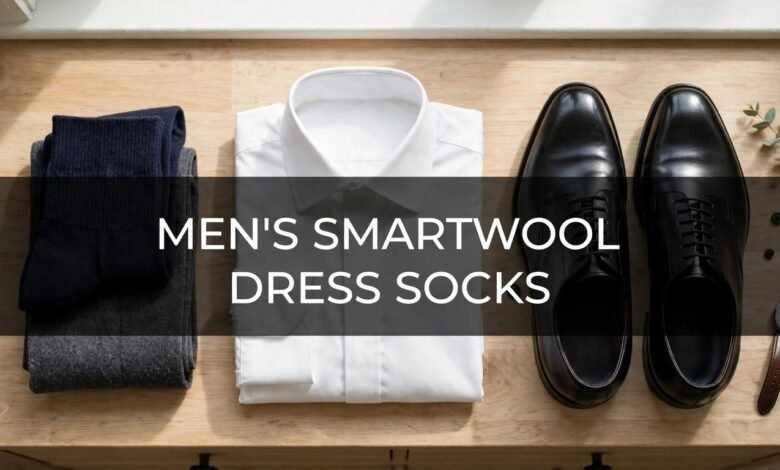
Most men never think twice about their socks until something goes wrong. A sock slides down inside a dress shoe halfway through a meeting. A toe seam rubs raw by lunchtime. Feet feel damp and warm by mid-afternoon, even though the shoes were fine that morning. These are small problems, but they sit at the bottom of every step you take, and over a long workday they add up.
Men’s Smartwool dress socks exist for exactly this gap. They take the merino wool performance that Smartwool built its name on in hiking and outdoor socks and put it into a slimmer, cleaner sock that works with dress shoes, loafers, and smart-casual outfits. The result is a sock that looks like an ordinary dress sock from the outside and behaves like a performance sock on the inside.
This guide covers what men’s Smartwool dress socks actually are, how merino wool works in a dress sock, how they fit, how to style them, how to care for them, and who should buy them. If you are considering a pair, or wondering whether they are worth the step up from basic cotton dress socks, you will find the answers here.
What Are Men’s Smartwool Dress Socks?
Men’s Smartwool dress socks are men’s socks made by Smartwool with a merino wool blend, designed to be worn with dress shoes and formal or smart-casual clothing. They are thinner and more refined than Smartwool’s hiking socks, with a clean look that suits an office, a wedding, or a smart dinner out.
Smartwool is a brand best known for merino wool socks for hiking, running, and outdoor use. Over the years, the company has extended the same materials and construction ideas into its Everyday line, which covers socks meant for daily wear rather than the trail. Dress socks sit in that everyday world. They use the same building blocks — merino wool, a supportive arch brace, a Virtually Seamless toe, and durability features such as Shred Shield technology — but in a zero-cushion or light-cushion profile that fits neatly inside a dress shoe without adding bulk.
The important thing to understand is that these are not hiking socks in a darker colour. A hiking sock is built for cushioning, impact, and thick boots. A dress sock is built for a close fit, a clean silhouette, and all-day comfort inside a shoe that was never designed with thick socks in mind. Smartwool’s dress socks are shaped around that second job.
The Everyday Line and Where Dress Socks Fit
Smartwool’s Everyday socks are the company’s daily-wear range. They include crew socks, ankle socks, and no-show styles in plain colours and simple patterns. Dress socks draw from this range: crew-height styles that sit comfortably above the ankle and below the calf, in colours such as black, charcoal, navy, and brown that pair naturally with suits and smart trousers.
The crew height matters more than it first seems. A dress sock that is too short leaves bare ankle visible every time you sit down and your trouser leg rides up. A crew sock covers that gap, which is one of the oldest rules of formal dressing. Smartwool’s Everyday crew socks are designed to stay put, with a comfort welt at the top that holds the sock in place without squeezing the calf.
Why Merino Wool Works in a Dress Sock
The core of a Smartwool dress sock is merino wool, and it is worth understanding what that fibre actually does, because it explains almost everything else about how these socks feel.
Merino wool comes from Merino sheep, and its fibres are much finer than ordinary wool. That fineness is why merino does not feel scratchy the way a cheap wool jumper might. Against the skin, a good merino blend feels soft and smooth, which matters in a sock you will wear for ten or twelve hours.
Temperature Regulation
Merino wool is known for temperature regulation. The fibre can absorb moisture vapour and release it slowly, which helps keep feet comfortable across changing conditions. In practice, this means the same pair of merino dress socks can feel comfortable in a warm office in summer and in a cold commute in winter. They do not overheat the foot the way a thick synthetic sock can, and they do not leave feet feeling cold and clammy the way thin cotton can when it gets damp.
This is the single biggest practical difference between merino dress socks and ordinary cotton dress socks. Cotton absorbs sweat and holds it. Once a cotton sock is damp, it stays damp, and damp feet feel cold in winter and uncomfortable in summer. Merino manages moisture far better, wicking sweat away from the skin and helping it evaporate.
Odour Resistance
Merino wool also has natural odour resistance. The fibre’s structure discourages the build-up of the bacteria that cause foot odour, and the moisture management helps too, since bacteria thrive in damp conditions. Nobody buys dress socks for this feature alone, but anyone who has taken off dress shoes after a long day will appreciate it. A pair of merino dress socks can often be worn a second day on a trip without the smell that a cotton pair would develop, although washing between wears is still the better habit.
Softness and Comfort
Smartwool uses ZQ-certified merino wool, which is a standard for responsibly sourced wool that meets defined standards for animal welfare, environmental care, and fibre quality. The practical result for the wearer is a consistently soft fibre. Combined with the brand’s Virtually Seamless toe — a toe closure designed to reduce the bulky seam that causes rubbing — the sock feels smooth inside the shoe from the first wear.
Key Features to Look For
When you look at a pair of men’s Smartwool dress socks, a few construction details tell you most of what you need to know.
Virtually Seamless Toe
The toe seam is the most common source of discomfort in a dress sock. A raised seam rubs against the toes with every step, and in a close-fitting dress shoe there is nowhere for the foot to escape it. Smartwool’s Virtually Seamless toe flattens that closure so the inside of the sock feels smooth across the toes. It is a small detail, but it is the difference between forgetting about your socks and thinking about them all day.
Arch Brace
Many Smartwool Everyday socks include a supportive arch brace — an elasticised band around the arch of the foot that helps the sock hug the foot and stay in place. In a dress sock, this does two things. First, it stops the sock from bunching or sliding down inside the shoe. Second, it gives a light sense of support under the arch, which is welcome during a long day on your feet. It is not a medical support device, and it does not replace an insole, but it does help the sock behave like it belongs on your foot rather than drifting around inside your shoe.
Shred Shield Technology
Shred Shield is Smartwool’s name for reinforcement in the toe area designed to reduce wear from toes. Dress shoes are hard on socks: the toe box is narrow, the foot slides slightly with each step, and the big toe does a lot of work. Reinforcing that area extends the life of the sock, which matters when a pair costs more than a basic three-pack. It does not make a sock indestructible — no sock is — but it addresses the exact spot where dress socks usually fail first.
Zero Cushion Profile
Most Smartwool dress-style socks use a zero-cushion profile, meaning there is no extra padding built into the sole. This is deliberate. A dress shoe has a fixed amount of room, and a cushioned sock changes the fit of the shoe. Zero cushion keeps the sock thin and close-fitting, so your shoes fit the way they were designed to fit. If you want cushioning, Smartwool’s light-cushion hiking and everyday socks offer it, but for dress shoes, thin is the right call.
Comfort Welt and Stay-Put Fit
The welt is the band at the top of the sock. On Smartwool’s Everyday crew socks, it is designed as a comfort welt: wide enough to distribute pressure and hold the sock up without leaving a mark or cutting into the calf. A sock that stays up all day without constant adjustment is one of those things you only notice when it is missing.
The Merino Blend
Smartwool dress socks are not pure wool. A typical Everyday sock blend is roughly half merino wool, with nylon for strength and a small amount of elastane for stretch and shape retention. The exact percentages vary by style — for example, some Everyday crew styles list around 54% wool, 43% nylon, and 3% elastane — but the pattern is consistent: wool for comfort and temperature control, nylon for durability, elastane for fit. This blend is also what makes the socks machine washable and practical for everyday use, where pure wool would be far more delicate.
How Men’s Smartwool Dress Socks Fit
Fit is where dress socks succeed or fail, and it is worth getting right before you buy.
Sizing
Smartwool sizes its men’s socks by US shoe size, and the brand’s guidance is generally to take your normal size. The socks are designed with a men’s specific fit, shaped to the contours of a man’s foot rather than a generic unisex shape. The elastane in the blend gives the sock stretch, so there is some forgiveness, but a sock that is a full size too small will pull tight across the toes and wear out faster, while a sock that is too large will bunch inside the shoe.
If you sit between sizes, the safer choice is usually the larger size. A slightly roomy sock can be managed; a tight sock cannot.
Height: Crew Is the Right Call
For dress wear, crew height is the standard choice. It covers the ankle and lower calf, so no skin shows when you sit or cross your legs. Smartwool’s Everyday crew socks sit at a comfortable mid-calf height. No-show and ankle styles have their place with loafers and casual shoes in summer, but they are not dress socks in the formal sense, and they leave the ankle exposed.
How They Should Feel
A well-fitting Smartwool dress sock should feel snug but not tight. The arch brace should sit under the arch, not halfway along the foot. The heel pocket should sit on the heel, not ride up the ankle or slide under the foot. The toe should reach the end of the sock without pulling, and the Virtually Seamless toe should feel smooth, not ridged. Walk around the room in your shoes for a few minutes when you first try a pair. Any pinching, bunching, or slipping in those first minutes will only get worse over a full day.
Styling Men’s Smartwool Dress Socks
Dress socks follow a few simple rules, and Smartwool’s plain colours make them easy to follow.
Match the Trousers, Not the Shoes
The classic rule is to match your socks to your trousers, not to your shoes. Black socks with black trousers, navy socks with navy trousers, charcoal with grey. The sock then extends the line of the trouser, which looks longer and cleaner. Matching the shoe instead can create a block of colour at the foot that breaks up the outfit.
Smartwool’s Everyday range covers the core colours — black, charcoal, navy, brown — so this rule is easy to follow without thinking about it.
Solid Colours for Formal Occasions
For a suit, a job interview, a wedding, or any formal setting, solid colours are the safe choice. A plain black or navy crew sock disappears into the outfit, which is exactly what a dress sock should do at a formal event. Patterns have their place — a subtle stripe or a restrained pattern can add personality to a smart-casual outfit — but the sock should never be the loudest thing you are wearing.
Smart-Casual and Everyday Wear
Away from formal settings, Smartwool dress socks work well with chinos, dark jeans, and loafers or derbies. The merino comfort is the same, and the clean look suits a smart-casual outfit better than a thick athletic sock. This is where the “everyday” part of the Everyday line earns its name: the same pair that works under a suit on Monday works under chinos on Saturday.
What Not to Do
A few mistakes come up again and again. White athletic socks with a suit are the most obvious, and the most avoidable. Socks that are too short, leaving bare ankle visible when seated, are the second. And wearing a thick cushioned sock inside a dress shoe that was fitted for a thin sock will make the shoe feel tight and can cause blisters. If your dress shoes feel tight, check the sock thickness before blaming the shoe.
Men’s Smartwool Dress Socks vs Cotton Dress Socks
The honest comparison is between a merino blend dress sock and an ordinary cotton dress sock, because that is the choice most men face.
Cotton dress socks are cheaper, widely available, and familiar. They look fine when new and they are easy to find in any colour. Their weakness is performance: cotton absorbs moisture and holds it, it loses its shape over time, and it wears thin at the heel and toe relatively quickly. A cotton dress sock can also feel cold and damp in winter once it has absorbed sweat.
Merino dress socks cost more per pair, but they manage moisture, resist odour, hold their shape better, and generally last longer with proper care. They are also more comfortable across a wider range of temperatures. The trade-off is price and care: merino blends need gentler washing than cotton, and they are not the sock to choose if you want the cheapest possible option.
For a man who wears dress shoes every day, the comfort difference over a working week is real. For occasional wear — a wedding, a funeral, a rare formal event — a cotton pair is perfectly adequate. The decision comes down to how often the socks will be worn and how much the comfort matters to you.
How They Compare to Other Merino Socks
Smartwool is not the only brand making merino socks, and Darn Tough is the name that comes up most often in comparison. Owners who have worn both often describe Darn Tough as the tougher, longer-lasting sock and Smartwool as the softer, more comfortable one, with a higher merino content in many styles. Both are well-regarded, and the choice often comes down to personal preference: if you prioritise a soft feel and all-day comfort in a dress shoe, Smartwool is a strong pick; if you prioritise maximum durability above all else, it is worth comparing the two directly. There is no single right answer, and both brands have loyal wearers for good reasons.
How to Care for Men’s Smartwool Dress Socks
Merino wool blends are easy to care for if you follow a few simple rules, and proper care is what turns a good pair of socks into a long-lasting one.
Wash them inside out in warm water on a gentle cycle, with a mild detergent. Avoid bleach, which damages wool fibres. Tumble dry on low heat, or line dry if you have the time — air drying is the gentlest option and helps the socks keep their shape. Do not iron them, and do not dry clean them.
The most common care mistake is heat. High dryer heat can shrink wool and wear out the elastane that gives the sock its stretch. Low heat, or no heat at all, keeps the fit consistent for much longer. The second mistake is washing them with heavy items such as jeans with zips or Velcro, which can snag and pill the wool. Turning the socks inside out before washing protects the outer surface.
With this kind of care, owners report Smartwool merino socks lasting for years, with some pairs surviving weekly washing for a long time with minimal pilling. Longevity depends on care and on how often the pair is worn, so rotating between several pairs will extend the life of each one more than any single washing trick.
Who Should Buy Men’s Smartwool Dress Socks?
These socks make the most sense for a specific kind of wearer. If you recognise yourself in the list below, they are probably worth trying.
You wear dress shoes most days, whether for work or for personal preference, and you want a sock that stays comfortable from morning to evening. You have feet that get warm or sweaty in ordinary socks, and you have noticed the difference that moisture management makes. You dislike toe seams, socks that slide down, or socks that need adjusting during the day. You are willing to pay more per pair for comfort and durability, and you are happy to wash them with a little care.
They make less sense if you rarely wear dress shoes, if you want the cheapest socks available, or if you prefer a thick cushioned sock even in dress shoes. In those cases, a basic cotton dress sock or a cushioned everyday sock is the more sensible buy.
Common Mistakes When Buying Dress Socks
A few buying mistakes are worth avoiding. Buying the wrong size is the first, and it is usually caused by guessing rather than checking the size chart against your shoe size. Buying a single pair to test is smarter than buying a week’s worth at once — wear one pair for a full day, including a long stretch of walking, before committing to more.
Choosing a pattern that is too loud for the setting is the second mistake. A novelty pattern can be fun with casual clothes, but it undermines a formal outfit. Keep the bold patterns for days when the dress code allows them.
Ignoring the shoe is the third. A dress sock is part of a system with the shoe. If the shoe is narrow, a thin zero-cushion sock is the right partner. If the shoe has room, a light-cushion sock can work. Match the sock to the shoe, not just to the outfit.
Finally, do not expect a dress sock to fix a shoe problem. If a dress shoe rubs or pinches, the cause is usually the shoe’s fit, not the sock. A good sock can reduce friction and improve comfort, but it cannot correct a shoe that is the wrong size or shape.
How Many Pairs Do You Need?
For daily office wear, five to seven pairs is a practical rotation. That gives you a clean pair every working day and a washing cycle that does not demand daily laundry. Because merino socks resist odour better than cotton, a rotation also lets each pair rest and dry fully between wears, which extends its life.
If you are trying Smartwool dress socks for the first time, start with two or three pairs in your most-worn colours — black and navy cover most wardrobes. Wear them for a couple of weeks, including at least one long day, and then decide whether to build the rotation out. This is a better approach than buying a full set on the strength of a single afternoon’s wear.
Frequently Asked Questions
Are Smartwool dress socks good for all-day wear?
Yes. They are designed for it. The merino wool blend manages moisture and temperature, the Virtually Seamless toe reduces rubbing, and the arch brace and comfort welt help the sock stay in place. Most wearers find them comfortable for a full working day, including days with a lot of walking. As with any sock, the fit has to be right — a sock in the wrong size will not be comfortable no matter how good the materials are.
Are men’s Smartwool dress socks warm in winter and cool in summer?
That is the main advantage of merino wool. The fibre helps regulate temperature, keeping feet warmer when it is cold and cooler when it is warm, largely because it manages moisture so well. They are not heavy winter socks — the zero-cushion dress profile is thin — but they handle a wider range of temperatures than a cotton dress sock of the same thickness.
Do Smartwool dress socks stay up?
In normal wear, yes. The comfort welt at the top is designed to hold the sock in place without squeezing, and the arch brace helps the sock grip the foot. Socks usually slide down because they are the wrong size, because the elastic has worn out, or because the sock is too thick for the shoe and gets pushed down as the foot moves. Buying the right size and replacing socks when the elastic fails solves most of it.
Can you wear Smartwool dress socks with loafers?
Yes, and they work well with loafers, derbies, and other smart shoes. A crew-height sock with loafers is a classic look. In warm weather, some men prefer a no-show sock with loafers for a sockless appearance, and Smartwool makes no-show styles with an internal heel gripper for that purpose. For a formal or office setting, the crew-height dress sock is the safer choice.
How do you wash Smartwool dress socks?
Machine wash warm, inside out, on a gentle cycle with mild detergent. Do not use bleach. Tumble dry on low heat or line dry. Do not iron and do not dry clean. Turning them inside out protects the outer surface, and low heat protects the wool and the elastane.
Are Smartwool dress socks worth the price?
That depends on how often you wear dress shoes. For daily wear, most buyers find the comfort, moisture management, and durability justify the higher price per pair, especially when the socks last for years with proper care. For occasional wear, a cheaper cotton dress sock does the job. The value is in the daily comfort, not in the label.
What is the difference between Smartwool dress socks and Smartwool hiking socks?
The difference is purpose. Hiking socks are built with cushioning, a taller profile, and reinforcement for boots and rough ground. Dress socks are thin, with a zero-cushion profile, a clean look, and a fit designed for dress shoes. They share the same merino wool and many of the same construction features, but they are shaped for different shoes and different days.
Conclusion
Men’s Smartwool dress socks are a simple idea done well: take a proven merino wool sock, make it thin and clean enough for a dress shoe, and keep the details that matter — a smooth toe, a supportive arch, a welt that stays up, and a reinforced toe that lasts. They will not transform your wardrobe, and they are not the cheapest socks you can buy. What they do is remove a small daily annoyance: feet that feel damp, socks that slip, and toe seams that rub.
If you wear dress shoes every day, that is worth something. Start with a couple of pairs in black or navy, wear them on a long day, and judge them on comfort at the end of it rather than on how they look in the packet. A dress sock earns its place the same way any good piece of clothing does — by being forgotten about while you get on with your day.
Read Also: Men’s Natural Antiperspirant Deodorant (2026 Guide)





One Comment