
Grenadier (2026 Guide): The Ineos Grenadier 4×4 Explained — Specs, Off-Road Ability & Ownership
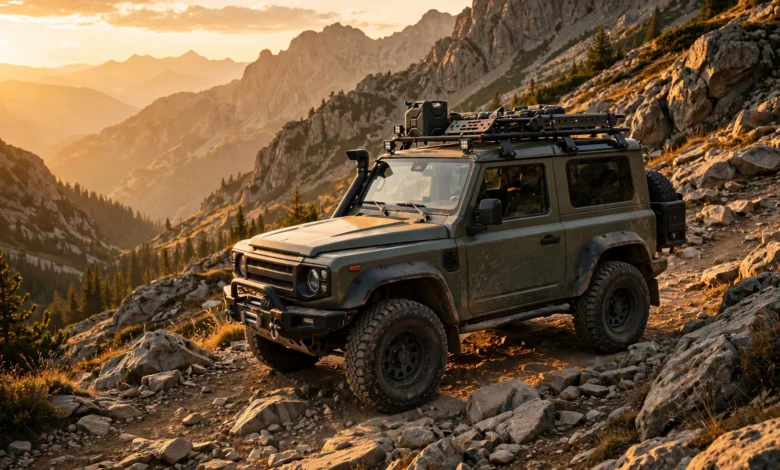
The Grenadier Grenadier is that rare thing: a vehicle that feels less like a product and more like a statement of intent. Take one look at the Ineos Grenadier and you know exactly what it’s about: a big, square-jawed, unapologetic 4×4 built for people who genuinely leave the tarmac behind — not for the school run dressed up in adventure branding. There’s no telly-sized touchscreen dominating the dash. No waffle about “lifestyle”. It’s a tool that happens to be enormous fun.
And yet, for something that looks like it drove straight out of 1985, the Grenadier is one of the newest names in motoring. A chemicals billionaire decided the world still needed a proper, honest off-roader, and — rather than just complaining about it at dinner parties — he built a car company to make one. Here’s the full story: what it is, how it’s engineered, what it’s like to drive and live with, and whether it deserves a place on your shortlist.
The bottom line: the Ineos Grenadier is a deliberately old-school 4×4 — box-section ladder-frame chassis, solid axles, BMW straight-six petrol and diesel engines — built from scratch by a startup to be the toughest utilitarian off-roader you can buy. Brilliant off road, charmingly agricultural on it.
- What Is the Ineos Grenadier?
- Design & Build: Old-School Engineering
- Off-Road Credentials
- Interior & Practicality
- On the Road: Daily Driving
- Trim Levels & Body Styles
- Comparison Table: Grenadier vs Its Rivals
- Who Is It For?
- Ownership Notes
- Frequently Asked Questions
- Conclusion: Should You Buy the Grenadier Grenadier?
What Is the Ineos Grenadier?
The Grenadier is the first vehicle from Ineos Automotive, the car-making arm of the Ineos chemicals empire founded by Sir Jim Ratcliffe. And its origin story is genuinely one of the best in the modern motor industry. Legend has it the idea was sketched out over drinks at the Grenadier pub in Belgravia, London — hence the name. Ratcliffe, a lifelong fan of the classic British workhorse 4×4, watched that icon disappear from production and decided the world still needed something like it: honest, rugged, repairable, and built for a working life rather than a showroom.
So instead of buying an existing brand, he started one. Ineos Automotive recruited engineers from across the industry, struck a deal with BMW for engines, and bought the former Smart car factory in Hambach, France, to build the thing. The Grenadier was revealed around the turn of the decade, with customer deliveries beginning around 2022 — an astonishingly quick turnaround for a from-scratch car company.
Fun fact: despite the boxy silhouette that nods to the great utilitarian 4x4s of the past, the Grenadier isn’t a retro pastiche or a copy of anything. Every panel and every bracket was engineered from a clean sheet, which is why Ineos could cherry-pick proven components — BMW engines here, a stout ladder frame there — without being tied to anyone else’s legacy compromises.
The pitch, then, is simple. While the rest of the 4×4 world has drifted upmarket — softer, plusher, more electronic — the Grenadier went the other way on purpose. It’s aimed squarely at the people the old-school off-roader used to serve: farmers, gamekeepers, utility crews, overlanders, and anyone who needs a vehicle that treats mud as a workplace rather than a photo opportunity.
Design & Build: Old-School Engineering
Pop the bonnet — or better yet, crawl underneath — and the Grenadier reads like a love letter to traditional 4×4 engineering. At its heart sits a proper box-section ladder-frame chassis, the old-fashioned separate-frame construction that the toughest off-roaders have always used. It’s heavier than a modern monocoque, but it’s stronger, easier to repair after a hard life, and far more tolerant of being twisted, loaded, and generally abused.
Hanging off that frame are solid beam axles front and rear, another deliberate throwback. Independent suspension rides better on the road, but beam axles are tougher, simpler, and keep the wheels planted over the kind of terrain that would tie a crossover in knots. Everything about the running gear says the same thing: durability first, comfort second.
Power comes from BMW-sourced 3.0-litre straight-six engines, in both petrol and diesel forms, driving through an eight-speed automatic gearbox. It’s a canny move — instead of developing its own engines from nothing, Ineos bought proven, refined, widely-understood units from one of the world’s best engine makers. The sixes are smooth, torquey, and well suited to hauling a heavy 4×4, and because they’re mainstream BMW units, any competent mechanic already knows their way around them.
The drivetrain is full-time four-wheel drive with a low-range transfer case and locking differentials — the holy trinity of serious off-roading. In plain English: power goes to all four wheels all the time, you can gear everything down for crawling over rocks or through mud, and you can lock the diffs so that a spinning wheel can’t steal all the drive. Few vehicles sold today offer the full set as standard thinking rather than an expensive options list.
Fun fact: the detailing is full of thoughtful, work-first touches — switches and dials sized to be operated with gloves on, exterior utility rails and lashing points, and a general sense that every control was designed by people who’ve actually stood in a rainy field trying to work a vehicle with cold hands.
Off-Road Credentials
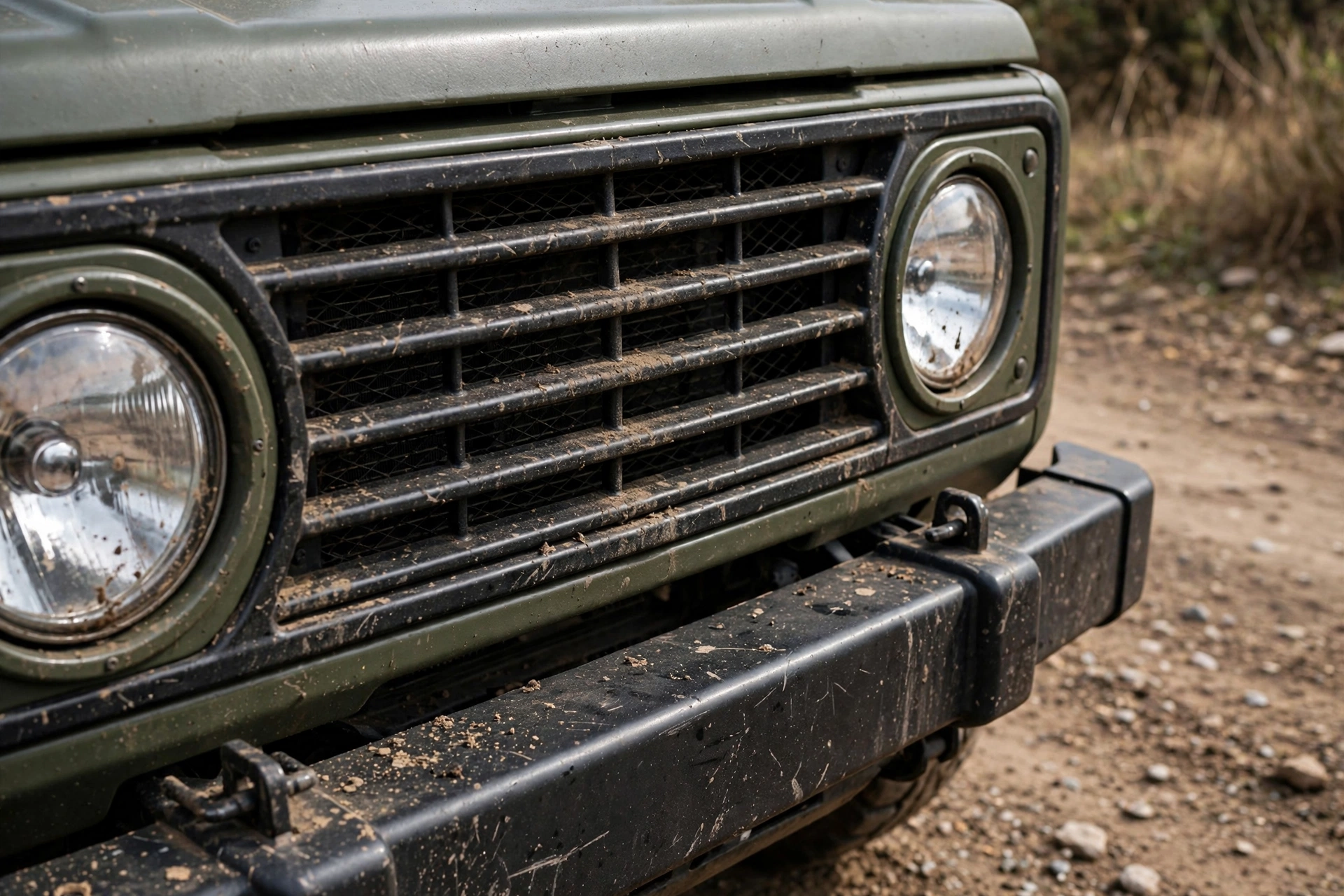
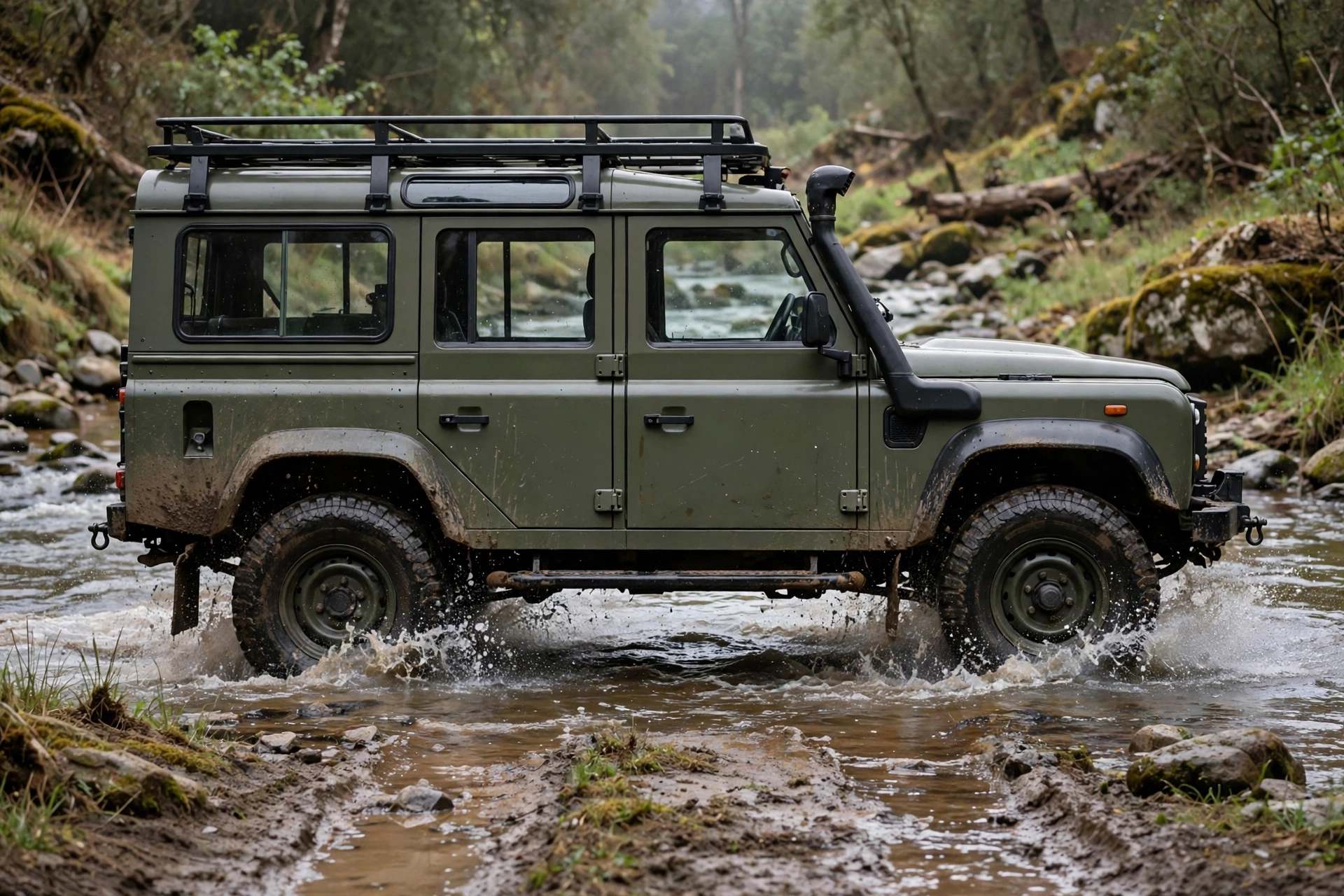
This is the whole point of the Grenadier, so let’s not dance around it: off the beaten track is where this vehicle earns its keep. The fundamentals are all present and correct — generous ground clearance to straddle ruts and rocks, a deep wading capability for flooded lanes and river crossings, and steep approach and departure angles so the bumpers don’t get ripped off on sharp crests and ditches.
Then there’s the stuff you can’t see in a brochure photo. The long-travel suspension and beam axles give excellent wheel articulation, meaning the tyres stay in contact with the ground over deeply uneven terrain instead of dangling in the air. The locking differentials and low-range gearing mean that when grip gets scarce, the Grenadier can meter out drive with real precision rather than relying on electronics to brake spinning wheels and hope for the best. Steel underbody protection shrugs off the inevitable scrapes.
It’s no surprise, then, who buys them. The Grenadier has found a natural home with farmers, estate managers, forestry workers, and utility companies — people for whom a vehicle is a tool that must start every morning and get home every night, whatever the weather did in between. Overlanders love it too: the old-school construction is exactly what you want when the nearest dealer is two countries away and the repair has to happen with hand tools.
The bottom line: on paper and in practice, the Grenadier is one of the most genuinely capable off-roaders on sale — not because of clever software, but because the hardware underneath is the right hardware. If your driving regularly involves places without road signs, very little else at this end of the market is built with the same single-mindedness.
Interior & Practicality
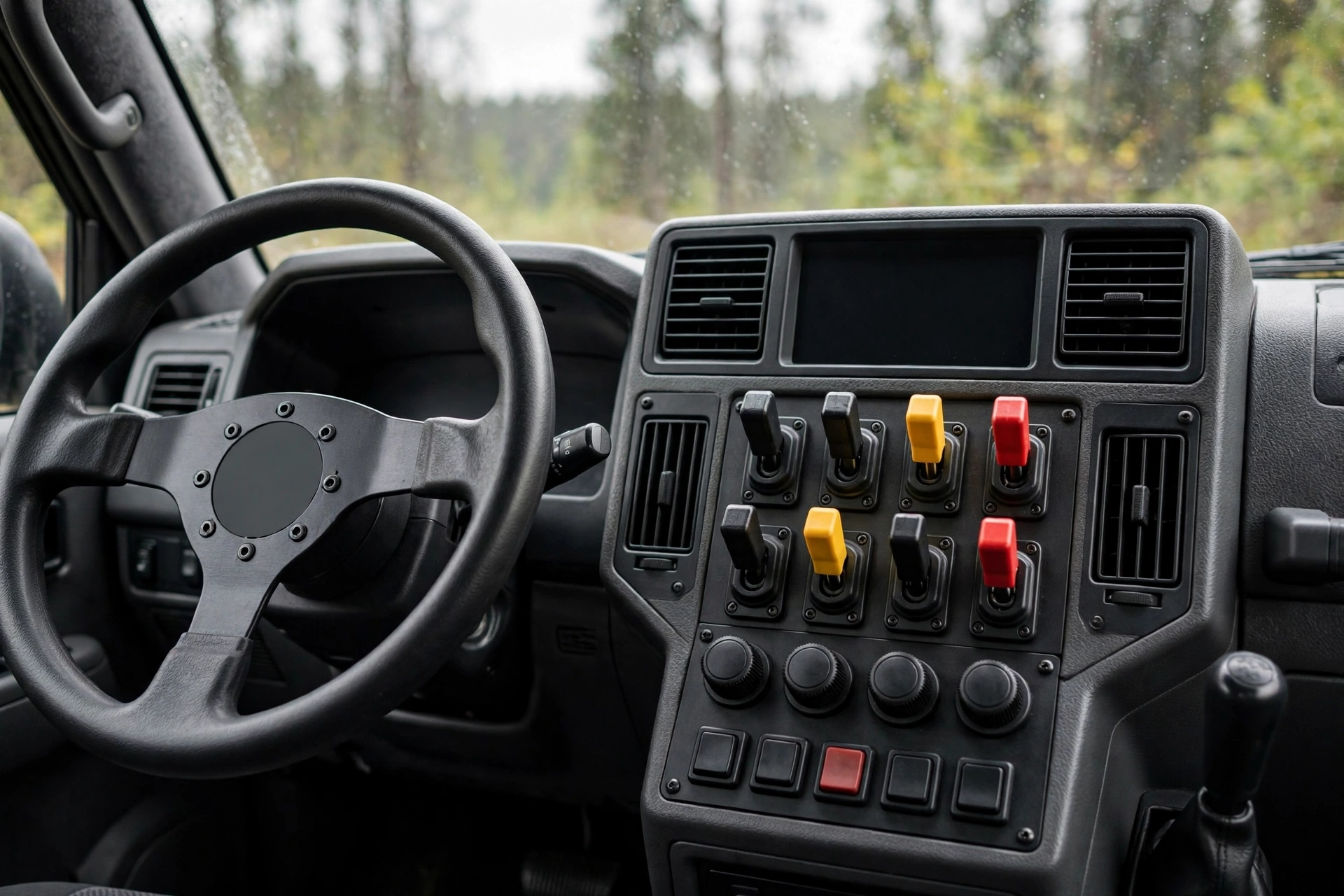
Step inside and the theme continues: this cabin was designed by people who hate fiddly touchscreens as much as you do. The dashboard is dominated by big, chunky physical controls — proper buttons, proper rotary dials, and an overhead switch panel with the vibe of a light aircraft’s cockpit. Everything is spaced out, clearly labelled, and operable with gloves. There’s a central display for navigation and vehicle settings, but it’s a sensible size and doesn’t try to run your life.
Materials are chosen for survival, not for showroom wow. Hard-wearing plastics, durable seat fabrics, and rubberised surfaces that don’t mind muddy boots or wet dogs. The floors are reportedly designed to be hosed out, with drain plugs to let the water escape — the kind of feature that tells you everything about the intended customer. This is a cabin you can clean with a pressure washer and a shrug, not one that needs a valet every fortnight.
Practicality is strong. Five adults fit with room to spare, the driving position is commanding with excellent visibility over the flat bonnet, and the load bay behind the rear seats swallows the usual country-life cargo — feed bags, toolboxes, gun cabinets, labradors. Fold the rear seats and it becomes a genuinely useful van-like space. Roof load options and a wide range of accessories mean overlanders can bolt on tents, racks, and storage to their hearts’ content.
Fun fact: the Grenadier’s switchgear layout was apparently benchmarked against being usable while bouncing across a field wearing thick winter gloves — which explains why everything feels oversized compared to a normal car’s dainty little buttons. Form follows function, aggressively.
On the Road: Daily Driving
Right, honesty time. A vehicle engineered this single-mindedly for the rough stuff is never going to feel like a luxury SUV on the motorway, and the Grenadier doesn’t pretend otherwise. The steering — a traditional recirculating-ball setup chosen for toughness — is vague around the straight-ahead by modern standards, and you find yourself making small corrections on long dual-carriageway runs. Body roll is present, wind noise is a travelling companion, and the tall, bluff shape is never going to slice through the air.
The engines help enormously, though. Those BMW straight-sixes are smooth and muscular, and they give the Grenadier an easy, loping gait that suits its character — it never feels strained, just unhurried. Around town the excellent visibility and square corners make it easy to place, and there’s something deeply relaxing about driving a vehicle that simply doesn’t care about potholes, speed bumps, or kerbs.
The bottom line: as a daily driver, the Grenadier is a compromise you make with open eyes. If most of your miles are motorway commuting, buy something else. But if your daily drive involves farm tracks, flooded lanes, or towing, and you value character over refinement, it’s weirdly lovable — a vehicle with an actual personality in a world of identikit crossovers.
Trim Levels & Body Styles
The core of the range is the Station Wagon — the classic five-door, five-seat 4×4 shape, available in editions pitched at different users. Broadly speaking, there’s a working, off-road-focused flavour with the hardcore hardware front and centre, and a slightly more lifestyle-oriented flavour for buyers who want the look and the capability without quite so much mud in the footwells. The differences are more about equipment and attitude than fundamentals: underneath, every Grenadier gets the same tough chassis and drivetrain philosophy.
Then came the pickup. A double-cab pickup variant — badged Quartermaster — followed later, stretching the formula with an open load bed for those who need to carry the messy stuff outside rather than in. It’s the natural second act for a utilitarian 4×4, and it pitches the Grenadier squarely at the working pickup market that values toughness over trinkets.
Fun fact: Ineos has also explored more specialised versions for commercial and emergency-service users, which makes perfect sense — a back-to-basics 4×4 with BMW mechanicals is exactly what fleet managers dream about when they’re speccing vehicles for hard lives in remote places.
Comparison Table: Grenadier vs Its Rivals
So how does the Grenadier stack up against the other serious names in the rough-and-ready 4×4 world? Each of these takes a very different route to a similar destination. (Where precise figures vary by market and spec, we’ve marked them as such — the philosophy matters more than the numbers here.)
| Model | Build philosophy | Drivetrain layout | Character | Best for |
|---|---|---|---|---|
| Ineos Grenadier | Old-school utilitarian, engineered from scratch | Full-time 4WD, low range, locking diffs | Honest workhorse with modern BMW power | Serious off-roaders, rural and working users |
| Land Rover Defender | Modern premium, tech-led | Full-time AWD with terrain electronics | Polished all-rounder | Families wanting capability plus comfort |
| Jeep Wrangler | Iconic American trail machine | Part-time 4WD (varies by market) | Playful adventurer | Weekend trail fun and open-air driving |
| Toyota Land Cruiser 70 | Legendary simplicity and reliability | Part-time 4WD (varies by market) | Indestructible workhorse | Remote-area reliability above all |
The pattern is clear. The Defender does everything with sophistication, the Wrangler does it with a grin, and the old Land Cruiser does it forever — while the Grenadier’s pitch is that it does it honestly, with traditional hardware and no pretence. Which one wins depends entirely on what you value: if you want a 4×4 that feels like a precision instrument rather than a gadget, the Grenadier’s old-school recipe is genuinely distinctive.
Who Is It For?
The Grenadier makes perfect sense for a particular kind of buyer, and very little sense for everyone else — which is exactly how its makers want it. It’s for the farmer who needs to check stock in a blizzard. The estate manager towing a trailer down a forestry track. The overlander planning a transcontinental trip where the repair manual matters more than the infotainment system. The shooting syndicate, the mountain rescue volunteer, the utility contractor.
It’s also, quietly, for the enthusiast who’s watched the classic 4×4 market go soft and wants the old feeling back — the mechanical honesty, the sense of a vehicle built to be kept for decades rather than leased for three years. There’s a romance to the Grenadier that spreadsheets can’t capture, and it explains why the order books found an audience far beyond the agricultural community.
Who should walk away? Anyone whose priorities are motorway refinement, fuel economy, or badge prestige. If your off-roading extends to a gravel car park, the Grenadier’s talents will be wasted on you — and its thirst and agricultural manners will annoy you daily. Buy the polished SUV instead, and let the Grenadier go to someone who’ll actually use the low-range gearbox.
Ownership Notes
Living with a Grenadier is refreshingly straightforward in some ways and worth going in with open eyes in others. Servicing is handled through Ineos’s own network of sales and service partners, which has been growing steadily since launch — but it’s still a young network, so check coverage near you before committing, especially if you’re rural. The good news is that the BMW-sourced engines and mainstream component choices mean most competent independent specialists won’t be fazed by the mechanicals.
Fuel economy is best described as “4×4-shaped”. A heavy, brick-like vehicle with big six-cylinder engines is never going to sip fuel, so budget accordingly and think of it as the price of the capability. Insurance is worth shopping around for: as a niche, high-value 4×4, quotes can vary wildly, and specialists who understand working and modified vehicles often come in keener than the big comparison-site brands. If you’re planning accessories — winches, roof tents, underbody protection — declare them properly.
On the plus side, residuals look encouraging. Niche vehicles with a loyal following and limited supply tend to hold their value well, and the Grenadier’s “they don’t make them like this any more — except they do” positioning gives it a cultish appeal that mass-market SUVs can’t match. Just remember it’s still a young brand: long-term reliability data is building, not established, so going in with a warranty and a good dealer relationship is simple common sense. For more automotive stories at adailyinsight360.com, there’s plenty more where this came from.
Frequently Asked Questions
Who makes the Ineos Grenadier?
The Grenadier is built by Ineos Automotive, a division of the Ineos chemicals group founded by British billionaire Sir Jim Ratcliffe. It’s a from-scratch car company — the Grenadier is its first vehicle — set up specifically to build a modern, no-nonsense utilitarian 4×4.
What engines does the Grenadier use?
BMW-sourced 3.0-litre straight-six engines, available in both petrol and diesel forms, paired with an eight-speed automatic gearbox. Ineos chose proven BMW units rather than developing its own engines, which means smooth, torquey performance and widely understood mechanicals.
Is the Ineos Grenadier actually good off road?
Yes — it’s the vehicle’s entire reason for existing. A box-section ladder-frame chassis, solid beam axles, full-time four-wheel drive, low-range gearing and locking differentials give it the traditional hardware that serious off-roading demands, backed up by generous clearance and deep wading ability.
Where is the Grenadier built?
It’s built in Hambach, France, at a factory Ineos bought from Smart. The plant was retooled to produce the Grenadier, which is one reason the company got from idea to customer deliveries so quickly.
Is there a pickup version of the Grenadier?
Yes — a double-cab pickup variant followed the original Station Wagon later, aimed at buyers who want an open load bed for working life. It keeps the same tough chassis and drivetrain philosophy as the wagon.
Is the Grenadier just a copy of the classic British 4×4?
No. The silhouette is a deliberate nod to the great utilitarian 4x4s of the past, but the Grenadier was engineered from a clean sheet with its own chassis, its own body, and bought-in BMW powertrains. Think spiritual successor, not replica.
Should I buy a Grenadier Grenadier as a daily driver?
Only if you know what you’re signing up for. It’s honest, charming, and superbly capable, and it’s also thirsty, noisy, and agricultural on the motorway. As a working vehicle or second car for country life, it’s superb; as a sole motorway commuter, a more conventional SUV will suit you better.
Conclusion: Should You Buy the Grenadier Grenadier?
The Ineos Grenadier shouldn’t really exist. A chemicals billionaire starting a car company from nothing to build an old-fashioned 4×4, in an era of electrification and autonomy, sounds like a pub fantasy — which, fittingly, is more or less where the idea began. But exist it does, and it’s all the better for its stubbornness. In a market full of soft-roaders pretending to be adventurers, the Grenadier is the real thing: ladder frame, beam axles, low range, lockers, and not an ounce of pretence.
It’s not perfect — it’s thirsty, it’s basic inside by modern standards, and on the road it reminds you constantly of its priorities. But perfection was never the brief. The brief was a tool: honest, tough, and built for a working life. On that measure, the Grenadier Grenadier doesn’t just succeed — it might be the most characterful new 4×4 on sale. And for more motoring coverage, keep an eye on adailyinsight360.com.
Read Also: Arsenal F.C. (2026 Guide): History, Trophies, Stadium & Key Facts





2 Comments