
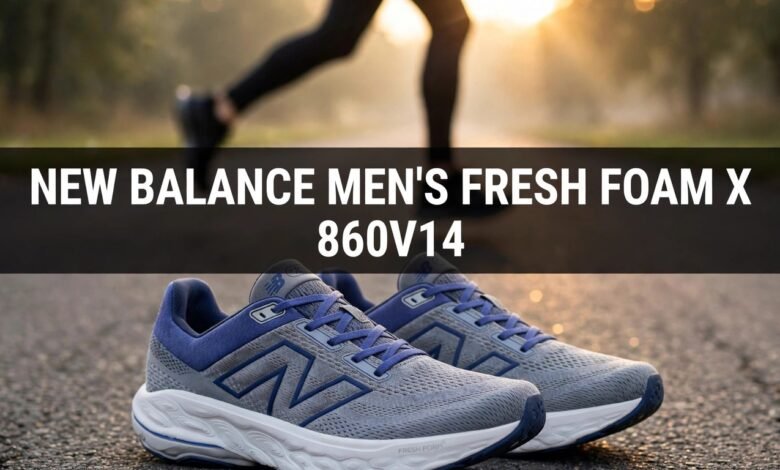
The New Balance 860 has been the brand’s dependable stability shoe for years. It was the shoe runners bought when they needed support, trusted it for daily miles, and came back to version after version. The New Balance Men’s Fresh Foam X 860v14 changes that formula more than any recent update, and it does so in a way that matters to anyone who runs in a support shoe.
The headline change is simple: the old medial post is gone. In its place is a stability plane — a thin layer of EVA film built into the midsole — working with a dual-density Fresh Foam X midsole that is softer on top and firmer underneath. The result is a stability shoe that feels softer and less intrusive than the 860s that came before it, while still guiding the foot for runners whose arches roll inward.
This guide looks at what the New Balance Men’s Fresh Foam X 860v14 is, how the new support system works, how it fits, how it runs, and who should buy it. Whether you are replacing an older 860, moving from a neutral trainer, or buying your first stability shoe, the details below will help you decide.
What Is the New Balance Men’s Fresh Foam X 860v14?
The New Balance Fresh Foam X 860v14 is a men’s stability road running shoe. It is the fourteenth version of the 860 line, and it is designed for daily training and long runs, with a particular focus on runners who overpronate — whose feet roll inward more than usual as they land and push off.
Stability shoes sit between neutral trainers and maximum-support shoes. A neutral shoe offers cushioning and lets the foot move naturally. A maximum-support shoe adds strong correction for severe overpronation. A stability shoe like the 860v14 adds gentle guidance: enough support to keep the foot aligned, without forcing it into a rigid position.
The 860v14 is positioned as a daily trainer rather than a racing shoe. It is built for the bulk of a runner’s weekly miles — easy runs, steady training days, and long runs — and it doubles as a comfortable walking shoe for runners who want one pair that covers both jobs. It is not designed for speed work or race day, and it does not pretend to be.
A Quick Note on the Name
New Balance’s naming can be confusing, so it is worth clearing up. “Fresh Foam X” is the name of New Balance’s premium foam cushioning, used across many of its running shoes. “860” is the model line, and “v14” means version 14. The full name — New Balance Fresh Foam X 860v14 — describes the shoe completely, but runners usually shorten it to “the 860v14”. The men’s version carries the style code starting M860, and it is sold in standard and wide widths, including a 4E extra-wide option in some markets.
The Big Change: The Stability Plane
To understand the 860v14, you have to understand what changed underneath the foot.
The Old Medial Post
Earlier versions of the 860 used a medial post — a firmer wedge of foam on the inner side of the midsole that resisted the foot rolling inward. It worked, and it was the standard approach to stability for many years, but it had a drawback: runners could feel it. The firmer wedge created a distinct sensation under the arch, and for some runners it felt intrusive, like the shoe was pushing back against the foot.
How the Stability Plane Works
The 860v14 replaces the medial post with what New Balance calls a stability plane. This is a thin film of EVA plastic that runs the full length of the shoe on the medial side and across the width of the shoe in the heel area. It is sandwiched between two layers of Fresh Foam X cushioning.
The idea is to slow down the speed at which the foot rolls inward, rather than blocking the movement outright. The film works with the firmer lower layer of foam to guide the foot gently, so the support feels less like a wall and more like a nudge. In practice, reviewers describe the ride as noticeably softer and smoother than the previous version, with the support present but harder to notice.
There is a trade-off, and honest reviews note it. Some testers found that the level of support in the 860v14 is a little less than in the 860v13 — one review put it at roughly four-fifths of the previous version’s support. For runners with mild to moderate overpronation, that is usually plenty. For runners with severe overpronation who relied on the firmest possible correction, it is worth trying the shoe on a run before committing, or comparing it with a more supportive option.
Fresh Foam X Midsole: Two Densities, One Ride
The midsole is the heart of the 860v14, and it is built from two different densities of Fresh Foam X.
The upper layer is the softer of the two. It sits directly under the foot and provides the plush, comfortable step-in feel that Fresh Foam X is known for. Independent lab testing has measured this top layer as very soft, which explains why the shoe feels cushioned the moment you put it on.
The lower layer is firmer. It provides the structure and the rebound, helping the shoe return energy as you push off and keeping the ride stable over longer distances. The firmer layer is also part of the support system, working with the stability plane to control the foot’s movement.
The drop — the difference in height between the heel and the forefoot — is 8mm, down from 10mm in the previous version. That lower drop, combined with the deeper cushioning, gives the shoe a more rockered shape from heel to toe, which helps it roll smoothly through each stride. The ride is often described as smooth and controlled rather than soft and bouncy: the foam absorbs impact well, but this is an EVA-based foam, so it does not give the springy, energetic return of the super-foams used in racing shoes.
Weight is around 300 grams per shoe, depending on size and width, which puts it on the heavier side for a daily trainer. That weight is the price of the support structure and the durable outsole. For a stability shoe, it is reasonable; for a runner who wants a light, fast-feeling shoe, it will feel substantial.
Upper, Fit, and Comfort
The upper of the 860v14 is a soft engineered mesh, designed to be breathable and to hold the foot securely without rubbing. It is seamless in the areas where friction usually occurs, and it is shaped to give a snug fit from the heel through the midfoot, with a little more room in the toe box so the toes can spread naturally.
Fit: True to Size, on the Snug Side
The general guidance from retailers is that the 860v14 fits true to size — take your normal running shoe size. However, the fit sits on the snug side, and some wearers and lab measurements have found it slightly small overall, with a narrower platform than some rival stability shoes. The narrower design is deliberate: it helps the stability features work by keeping the foot centred over the midsole.
If you have wide feet, or if you prefer a roomier fit, the wide widths are worth considering. New Balance sells the 860v14 in multiple widths, including wide and extra-wide options, which is one of the brand’s long-standing strengths. A runner with wide feet who buys the standard width and finds it tight is usually better served by the wide version than by sizing up in length, which changes the fit everywhere else.
The heel counter is noticeably stiffer than in many rival shoes, and it does a good job of locking the heel in place. That is useful in a stability shoe, where a secure heel helps the support system do its job, but it also means the shoe needs a short break-in period for some runners. The gusseted tongue and stretch laces help hold the midfoot securely, and the tongue is designed to stay in place rather than sliding to one side during a run.
Comfort for Walking and All-Day Wear
One of the 860v14’s strengths is that it works well beyond running. The cushioning, the secure fit, and the stable platform make it a comfortable walking shoe, and many buyers use it as an everyday shoe for work or travel. The breathable mesh upper keeps the foot ventilated, and the shoe’s structure gives it a more supportive feel than a casual sneaker. If you are looking for one pair of shoes that covers daily training and a lot of walking, this versatility is a genuine selling point.
Outsole and Durability
The outsole uses New Balance’s Ndurance rubber, placed in the high-wear zones where the shoe meets the ground. Ndurance is a durable rubber compound designed to resist wear over many miles, and it provides reliable traction on dry and wet pavement.
The outsole design leaves some midsole foam exposed under the heel and midfoot. This saves weight and keeps the landings soft, but it also means the exposed foam will wear faster than rubber in those areas. It is a common design choice in modern running shoes, and it is a reasonable trade-off for a daily trainer.
Mileage expectations for a shoe like this are typically in the range of 300 to 500 miles, depending on the runner’s weight, running style, and the surfaces they run on. Heavier runners, runners who strike hard on the heel, and runners who train mostly on rough roads will wear a pair out sooner; lighter runners on smooth surfaces will get more. The usual signs that a pair is done are a flattened, compressed midsole that no longer absorbs impact, worn-out rubber in the heel or forefoot, and new aches in the knees or feet that were not there when the shoe was fresh.
One honest caveat from independent lab testing is worth mentioning: the durability of the 860v14’s upper and some of its materials measured below average in laboratory tests, even though the outsole rubber itself is durable. In real-world use, most runners will not notice this over a normal lifespan, but it is worth knowing if you are particularly hard on shoes or if you plan to use the pair for very high mileage.
How the 860v14 Runs
On the run, the 860v14 feels like a mature, dependable stability shoe. The first thing most runners notice is the softness of the step-in: the top layer of Fresh Foam X is genuinely plush, and the shoe feels comfortable immediately. The second thing is the smoothness of the transition. The rockered shape and the 8mm drop help the shoe roll from landing to toe-off without any abrupt moments, and the ride feels controlled and even.
The support is there, but it is subtle. Runners who overpronate will feel the shoe guiding the foot, but not forcing it. The stability plane does its work quietly, which is a clear improvement over the old medial post for runners who found that sensation distracting. The firmer lower foam layer gives the shoe a grounded, stable feel underfoot, rather than the soft, sinking feeling of a heavily cushioned neutral shoe.
Where the shoe is less impressive is energy return and pace. This is not a shoe that makes you feel faster. The Fresh Foam X midsole absorbs shock well — lab tests have measured strong shock absorption in both the heel and the forefoot — but it returns only a moderate amount of energy, and the shoe’s weight holds it back when you try to pick up the pace. For tempo runs or intervals, a lighter shoe would be a better tool. For easy miles and long runs, the 860v14 is in its element.
Best Uses
Daily training is the 860v14’s home ground. It is built for the easy and steady runs that make up most of a training week. Long runs suit it well too: the cushioning holds up over distance, the support keeps the foot aligned as form tires, and the comfortable upper reduces the risk of hot spots late in a run.
It also works for recovery runs, when the goal is to move gently and let the legs recover, and for walking, where its stability and cushioning are a real advantage. It is less suited to speed work, racing, and trail running. The outsole is designed for roads and pavements, not for loose or muddy surfaces, and the shoe’s weight and structure are wrong for a fast race-day effort.
Who Should Buy the 860v14?
The 860v14 is a good match for a clear set of runners.
You overpronate mildly or moderately, and you want a shoe that guides your foot without feeling rigid or intrusive. You run regularly on roads and you need a dependable daily trainer for easy runs and long runs. You value comfort and stability over light weight and speed. You have had a good experience with the 860 line before and you want the newest version. Or you need a shoe that also works well for walking and all-day wear.
It is a weaker match if you are a neutral runner with no overpronation — a neutral trainer will feel freer and often lighter. It is also a weaker match if you want a racing shoe, a tempo shoe, or a trail shoe, or if you have severe overpronation and need the firmest support available. In that last case, it is worth trying the 860v14 on a proper run and comparing it with a maximum-support option before deciding.
The 860v14 vs the 860v13
Many buyers will be choosing between the new version and the older one, often because the v13 is available at a lower price once the v14 is out. The differences are worth knowing.
The v14 has the stability plane instead of the medial post, which makes the ride softer and the support less noticeable. The drop is lower, at 8mm compared with 10mm, and the midsole is deeper, with a more rockered shape. The upper is softer and the fit is a little more secure, with an improved gusseted tongue. The v13, by contrast, offers slightly stronger support and a firmer, more traditional stability feel.
If you liked the v13 and your overpronation is moderate, the v14 is a natural step forward and most runners will prefer the softer ride. If you have severe overpronation and you relied on the v13’s firmer correction, the v14’s gentler support may feel like a step back, and it is worth testing before you switch. If the v13 is available at a good discount and you were happy with it, there is no shame in staying with the older version — a known, comfortable shoe at a lower price is often the smarter buy.
How It Compares to Rivals
The stability category is competitive, and two comparisons come up often.
Against the ASICS Gel-Kayano, the long-standing rival in this category, the 860v14 is generally the softer and more affordable option, while the Kayano is often described as the more premium, more structured shoe. Runners who prefer a plush feel and a lower price tend to lean towards the 860v14; runners who want maximum structure and are happy to pay for it tend to lean towards the Kayano.
Against the Saucony Hurricane, a newer rival in the stability category, the 860v14 is the firmer, more grounded shoe. The Hurricane’s top-layer foam is softer and springier, and its support system centres the foot more actively. The 860v14, by contrast, feels sturdier and more controlled, with a stiffer upper and a more deliberate ride. The choice between them often comes down to whether you prefer a softer, more responsive feel or a firmer, more planted one.
Neither comparison has a single right answer. Stability shoes are personal: the right one is the one that feels good on your foot, over your usual distance, on your usual surfaces.
Price and Value
The 860v14 launched at a suggested retail price of $140, which is standard for a stability daily trainer from a major brand. In the UK, it is commonly listed around £140. That price puts it in the middle of the stability category: more expensive than budget stability shoes, less expensive than premium options such as the Gel-Kayano.
Value depends on how you use it. If it becomes your daily trainer and your walking shoe, covering several hundred miles plus daily wear, $140 is reasonable for what it delivers. If you only run occasionally, a cheaper stability shoe may cover your needs. It is also worth watching for discounts on the previous version, and for sales on the v14 itself once it has been out for a while, since running shoes are regularly discounted.
When you buy, check the width options and the return policy. A stability shoe needs to be tested on a run, not just tried on in the shop. Many running retailers allow returns after a short trial run, which is the best way to know whether the support and the fit are right for you.
Buying and Sizing Tips
A few practical tips will help you get the right pair the first time.
Buy your normal running shoe size first, but be aware the fit is snug. If you are between sizes or you have wide feet, consider the wide version rather than sizing up in length. Try the shoes on with the socks you run in, not with thin dress socks, because the sock changes the fit.
Walk and jog in the shop if you can, and pay attention to the heel. It should feel locked in, without slipping, and the arch area should feel supported without pressure. The toe box should give your toes room to spread, and the widest part of your foot should sit comfortably in the widest part of the shoe.
If you are switching from a neutral shoe, give the 860v14 a few runs to adjust. The support will feel different at first, especially if you are used to a shoe that lets your foot move freely. A little awareness of the support in the first run or two is normal. Persistent discomfort or pain is not, and if the shoe still feels wrong after several runs, it is probably not the right shoe for you.
Frequently Asked Questions
Is the New Balance 860v14 good for overpronation?
Yes, that is its main purpose. The 860v14 is a stability shoe designed for runners whose feet roll inward. Its stability plane and dual-density Fresh Foam X midsole slow down that inward roll and guide the foot into a more neutral position. It is best suited to mild to moderate overpronation. Runners with severe overpronation may find the support slightly less firm than the previous version, so it is worth testing on a run.
Is the 860v14 a neutral or stability shoe?
It is a stability shoe. It is built for runners who need support, and its defining feature is the stability plane that replaces the old medial post. Neutral runners who do not overpronate will usually be happier in a neutral trainer, which is lighter and lets the foot move more freely.
Does the 860v14 fit true to size?
Retailers generally list it as true to size, so your normal running shoe size is the right starting point. The fit is on the snug side, though, and some wearers find it slightly small. If you have wide feet, look at the wide and extra-wide versions, which New Balance offers for this model. Trying the shoe on with your running socks is the best way to judge.
How much does the 860v14 weigh?
It weighs around 300 grams per shoe, depending on size and width, which is roughly 10.7 to 11 ounces. That is on the heavier side for a daily trainer, and it reflects the support structure and the durable outsole. For a stability shoe it is reasonable, but runners who prioritise light weight may find it substantial.
Is the 860v14 good for walking?
Yes. The cushioning, the stable platform, and the secure fit make it a comfortable walking shoe, and many owners use it as an everyday shoe as well as a running shoe. The breathable mesh upper and the supportive structure suit long days on your feet. It is one of the more versatile shoes in the stability category.
What is the drop on the 860v14?
The heel-to-toe drop is 8mm, down from 10mm on the previous version. The lower drop, combined with the deeper midsole, gives the shoe a more rockered shape that rolls smoothly from heel to toe.
How long does the 860v14 last?
For most runners, a pair lasts around 300 to 500 miles, depending on body weight, running style, and surfaces. The Ndurance rubber outsole is durable, but the midsole foam compresses over time and gradually loses its cushioning. Replace the shoes when the midsole feels flat, the outsole is worn through in places, or you start noticing new aches that were not there when the shoes were new.
Is the 860v14 good for flat feet?
It can be. Flat feet often go with overpronation, and the 860v14 is designed for exactly that pattern. The arch support in the shoe comes from its structure rather than from a built-up arch, so it suits many flat-footed runners. However, flat feet vary a lot, and a runner with flat feet and specific pain or a diagnosed condition should consider advice from a specialist rather than relying on a shoe alone.
Conclusion
The New Balance Men’s Fresh Foam X 860v14 is the most significant rethink of the 860 line in years, and it is mostly a successful one. The stability plane replaces the intrusive medial post with a gentler, quieter form of support, and the dual-density Fresh Foam X midsole delivers a soft step-in with a stable, controlled ride underneath. It is comfortable, well built, versatile enough for walking and daily wear, and fairly priced for its category.
It is not perfect. It is heavier than a neutral trainer, it will not make you faster, and its support is a little gentler than the previous version, which matters if you need the firmest correction available. But for the runner it is made for — someone who overpronates mildly or moderately and wants a dependable, comfortable daily trainer — it does its job well.
If you are replacing an older 860, the v14 is a natural next step, and the softer ride is an upgrade most runners will welcome. If you are new to stability shoes, try it on a real run before you decide, and compare it with a rival or two. The right stability shoe is the one that disappears on your foot and lets you run without thinking about your feet, and for a lot of runners, the 860v14 is that shoe.
Read Also: Men’s Smartwool Dress Socks for Work and Everyday Wear




One Comment