What Is the Eucharist? (2026 Guide): Meaning, History and How Christians Celebrate It
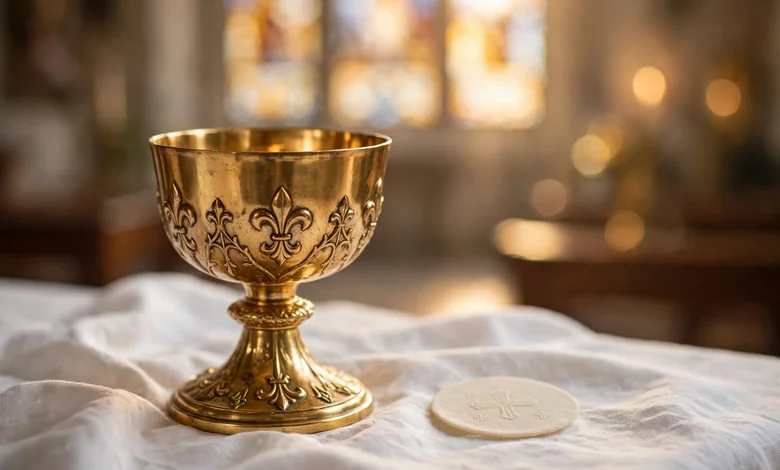
The Eucharist is the central act of worship in Christianity — a sacred meal of bread and wine that Christians have shared for nearly two thousand years to remember Jesus Christ. If you have ever wondered what actually happens during that quiet moment in a church service, why it matters so much, or how different churches understand it, this guide walks you through it all in plain language.
The bottom line: The Eucharist (also called Holy Communion, the Lord’s Supper, or the Mass) comes from a Greek word meaning “thanksgiving.” It traces back to the Last Supper Jesus shared with his disciples, and Christians celebrate it as a way of remembering his death and resurrection — though Catholics, Orthodox, and Protestants understand exactly what happens in the bread and wine quite differently.
In this guide:
- The Short Answer: What Is the Eucharist?
- Where the Word “Eucharist” Comes From
- The Biblical Roots: The Last Supper
- How Christians Understand It: Five Main Views
- The Elements: Bread and Wine
- How the Eucharist Is Celebrated Around the World
- First Communion and Who Can Receive
- Eucharist vs. Communion vs. Lord’s Supper
- Common Misunderstandings
- Frequently Asked Questions
- Conclusion
The Short Answer: What Is the Eucharist?
The Eucharist is a Christian sacrament in which believers eat bread and drink wine (or grape juice in some traditions) in remembrance of Jesus Christ. It is one of the oldest continuous rituals in the world — practiced in some form by nearly every Christian church, from a grand cathedral Mass to a simple gathering in a living room.
At its heart, the Eucharist does three things at once. It remembers — looking back at the Last Supper and Christ’s sacrifice. It celebrates — Christians believe Christ is somehow present in the meal. And it unites — sharing one loaf and one cup binds a congregation together as one body.
Fun fact: The Eucharist is so central to Catholic life that the Catholic Church calls it the “source and summit of the Christian life.” For many Protestants, meanwhile, it sits alongside baptism as one of only two sacraments they observe.
Where the Word “Eucharist” Comes From
The word “Eucharist” comes from the Greek eucharistia, which means “thanksgiving” or “gratitude.” It is the same root you might recognize in the word “eulogy” — literally a word of thanks or praise.
The New Testament itself uses this word. When the Gospels describe Jesus at the Last Supper, they say he “gave thanks” (eucharisteo) before breaking the bread. The earliest Christians picked up that language, and by the second century, writers like Justin Martyr were already calling the meal itself “the Eucharist.”
That is worth sitting with for a moment: the name of Christianity’s most sacred ritual is, at its root, simply saying thank you. Whatever else churches believe about it, gratitude is baked into the name.
The Biblical Roots: The Last Supper
Every Eucharistic celebration points back to one meal: the Last Supper, the Passover dinner Jesus shared with his twelve disciples on the night before his crucifixion.
The Four Biblical Accounts
The story is told in three of the four Gospels — Matthew, Mark, and Luke — plus a retelling by the Apostle Paul. Each account follows the same shape:
- Jesus takes bread, gives thanks, breaks it, and says, “This is my body.”
- He takes a cup of wine, gives thanks, and says, “This is my blood of the covenant.”
- He tells the disciples to eat and drink — and, in Luke and Paul’s versions, adds, “Do this in remembrance of me.”
John’s Gospel tells the Last Supper story differently — it focuses on Jesus washing the disciples’ feet — but it includes the famous “Bread of Life” teaching in John chapter 6, where Jesus says, “I am the bread of life… unless you eat the flesh of the Son of Man and drink his blood, you have no life in you.” That passage has fueled two thousand years of debate about what, exactly, Jesus meant.
Why It Was a Passover Meal
The bottom line: The Last Supper was not a random dinner. It was a Passover meal — the Jewish festival remembering God’s rescue of Israel from slavery in Egypt. That context matters enormously. At Passover, Jews ate unleavened bread and drank wine while retelling a story of deliverance through sacrifice.
Jesus took that ancient framework and gave it new meaning: just as the Passover lamb’s blood had marked Israel for rescue, he presented himself as the one whose death would bring a deeper rescue. Christians have been unpacking that parallel ever since.
The Early Church Carried It On
The Eucharist did not wait centuries to become important. The Book of Acts describes the first Christians meeting regularly for “the breaking of bread.” Paul’s letters — written within a few decades of Jesus’s death — already give instructions about how to celebrate it properly, warning believers not to take it lightly (1 Corinthians 11).
By around the year 150, Justin Martyr wrote a detailed description of a Sunday Eucharist that would look surprisingly familiar today: readings from Scripture, a sermon, prayers, the sharing of bread and wine, and a collection for the poor. The ritual took shape fast, and its core has barely changed since.
How Christians Understand It: Five Main Views
Here is where things get genuinely interesting — and where Christians honestly disagree. Everyone agrees the Eucharist matters; they disagree about what happens in the bread and wine. Here are the five main positions:
| View | Held By | What It Teaches |
|---|---|---|
| Transubstantiation | Roman Catholic Church | The bread and wine truly become the body and blood of Christ, though they still look and taste like bread and wine. Defined at the Fourth Lateran Council (1215) and reaffirmed at the Council of Trent. |
| Mystery / Real Presence | Eastern Orthodox Churches | The bread and wine truly become Christ’s body and blood, but exactly how is a holy mystery — the Orthodox deliberately avoid over-defining it. |
| Sacramental Union | Lutherans | Christ’s body and blood are truly present “in, with, and under” the bread and wine. The elements remain bread and wine, yet Christ is genuinely there. |
| Spiritual Presence | Reformed / Presbyterian / many Anglicans | Christ is truly present, but spiritually — received by faith — rather than in the physical elements themselves. |
| Memorial | Baptists, many evangelicals | The bread and wine are symbols. The meal is a memorial — a powerful act of remembering Christ’s death, but the elements themselves don’t change. |
Fun fact: These differences were not just academic debates. In the 1500s, disagreements about the Eucharist helped split Western Christianity during the Reformation. Martin Luther and Ulrich Zwingli — both reformers — famously failed to agree on the Lord’s Supper at a 1529 meeting in Marburg, and their churches went separate ways partly over this one question.
What is striking today is how much common ground has quietly grown back. In recent decades, Catholic, Lutheran, Anglican, and Methodist theologians have issued joint statements finding far more agreement on the Eucharist than anyone expected a century ago. The disagreements are real, but the shared meal keeps pulling Christians toward each other.
The Elements: Bread and Wine
The Eucharist uses startlingly ordinary stuff: bread and wine. Not gold, not incense — the everyday food and drink of the ancient Mediterranean world.
The Bread
Different traditions use different bread, and each choice carries meaning:
- Unleavened wafers: The Catholic Church (and many others) uses thin, unleavened wafers — connecting the meal to the Passover, when Jews ate unleavened bread in haste.
- Leavened bread: Eastern Orthodox churches use leavened bread, seeing the risen, “living” loaf as a symbol of the resurrection.
- Ordinary loaves: Many Protestant churches simply break a regular loaf, emphasizing the shared, everyday nature of the meal.
The Wine
Wine is the traditional cup, echoing the Last Supper. Some Protestant churches — particularly in the Methodist, Baptist, and Pentecostal traditions — use grape juice instead, a practice that grew in the 1800s alongside the temperance movement. The reasoning is practical: everyone, including children and those avoiding alcohol, can share the cup.
The bottom line: Whether wafer or loaf, wine or juice, every tradition is pointing at the same thing — the simplest possible meal, made sacred by what it remembers.
How the Eucharist Is Celebrated Around the World
Walk into different churches on a Sunday morning and the Eucharist can look remarkably different — even though everyone is doing, at root, the same thing.
The Catholic Mass
In a Catholic Mass, the Eucharist is the climax of the service. The liturgy moves through readings, a homily, and prayers, then reaches the Eucharistic Prayer — the long prayer of consecration over the bread and wine. The priest elevates the host, the congregation kneels, and communicants come forward to receive. Many Catholics attend Mass weekly; in many places, daily Mass is offered too.
Catholic churches also practice Eucharistic adoration — times of silent prayer before the consecrated host displayed in a monstrance. And the reserved sacrament is kept in a tabernacle, often with a small sanctuary lamp burning nearby as a sign of Christ’s presence.
The Orthodox Divine Liturgy
Eastern Orthodox Christians celebrate the Divine Liturgy, usually on Sundays and feast days. The service is long, sung almost entirely, and rich with incense and icons. The faithful receive both the bread and the wine together — the priest places a small piece of leavened bread soaked in wine into the communicant’s mouth with a spoon.
Orthodox churches take the “mystery” language seriously: the transformation of the gifts is real, but the Church refuses to nail down the mechanics. It simply is.
Anglican and Lutheran Services
Anglicans call it Holy Communion or the Eucharist; Lutherans often say Holy Communion or the Lord’s Supper. The service follows a liturgical shape similar to the Mass — readings, sermon, Eucharistic prayer, distribution. Lutherans typically commune kneeling at the altar rail, and many Anglican parishes offer the Eucharist weekly.
Evangelical and Free Church Observance
In Baptist, Pentecostal, and nondenominational churches, the Lord’s Supper is usually simpler and less frequent — monthly or quarterly is common. There is no altar; a table at the front holds the bread and cups. Deacons or elders distribute small pieces of bread and individual cups of juice, often while the congregation sings or prays quietly. The emphasis falls on personal remembrance and self-examination.
First Communion and Who Can Receive
Who gets to take part? The answer varies — and it is one of the most practically important differences between traditions.
- Catholic: Children typically make their First Holy Communion around age 7 or 8, after preparation classes. Only Catholics in good standing are invited to receive.
- Orthodox: Infants receive communion from baptism onward — there is no “first communion” milestone as a separate event.
- Lutheran/Anglican: Children are usually confirmed (or instructed) first, often in early teens, though practices vary widely by parish.
- Baptist/evangelical: Generally open to all baptized believers; the emphasis is on each person’s own faith and self-examination.
This is where the terms open and closed communion come in. Open communion means any baptized Christian may participate. Closed (or “close”) communion restricts it to members of that church or denomination. The practice reflects how seriously each tradition takes the unity the meal is supposed to express — if the Eucharist declares “we are one body,” churches want the people sharing it to actually be united in faith.
Fun fact: In the early church, there was a part of the service called the “Mass of the Catechumens” — newcomers and seekers had to leave before the Eucharistic prayer began. The meal was that sacred, and that protected.
Eucharist vs. Communion vs. Lord’s Supper: What’s the Difference?
People use these terms interchangeably, but each one highlights a different facet:
| Term | Emphasis | Most Common Among |
|---|---|---|
| Eucharist | Thanksgiving — gratitude to God | Catholics, Orthodox, Anglicans, Lutherans |
| Holy Communion | Union — with Christ and each other | Anglicans, Methodists, Lutherans |
| Lord’s Supper | Remembrance — the Last Supper meal | Baptists, Presbyterians, evangelicals |
| The Mass | The whole liturgy culminating in the sacrament | Roman Catholics |
| Divine Liturgy | The heavenly worship joined on earth | Eastern Orthodox |
They all describe the same meal. The different names are like different camera angles on one scene — each tradition’s vocabulary reveals what it finds most precious about it.
Common Misunderstandings
“It’s just a symbol, right?” That depends entirely on who you ask. For memorial-view Christians, yes — a powerful symbol. For Catholics, Orthodox, Lutherans, and many Anglicans, no — they believe Christ is truly present in a way that goes beyond symbolism. Treating everyone’s view as “just symbolic” misses what most of the world’s Christians actually believe.
“Catholics re-sacrifice Christ at every Mass.” This is a common Protestant misunderstanding of Catholic teaching. The Catholic Church teaches that the Mass re-presents the one sacrifice of Christ — it makes that single event present again — rather than repeating or adding to it.
“You have to be perfect to receive.” Paul’s warning in 1 Corinthians 11 about receiving “in an unworthy manner” is about attitude — division, selfishness, drunkenness at the meal — not about achieving sinlessness first. Every tradition agrees the Eucharist is for imperfect people; that is rather the point.
“It’s a Catholic-only thing.” Not even close. The Orthodox Divine Liturgy, Lutheran communion, Anglican Eucharist, and evangelical Lord’s Supper all flow from the same source. Roughly two billion Christians worldwide share in some form of this meal.
Frequently Asked Questions
What does the Eucharist mean literally?
It comes from the Greek eucharistia, meaning “thanksgiving.” The name reflects the gratitude at the heart of the meal — thanks for Christ’s life, death, and resurrection.
Is the Eucharist the same as Communion?
Essentially, yes. “Eucharist,” “Holy Communion,” and “the Lord’s Supper” are different names for the same sacrament, each emphasizing a different aspect: thanksgiving, unity, and remembrance.
How often do Christians celebrate the Eucharist?
It varies widely. Many Catholic and Orthodox churches celebrate daily or weekly; Anglicans and Lutherans usually weekly; Baptist and evangelical churches often monthly or quarterly.
Can non-Christians take Communion?
Generally, no — churches ask that only baptized believers participate, since the meal expresses a shared faith. Visitors are usually welcome to come forward for a blessing instead, or simply remain seated. When in doubt, watch what others do or ask beforehand.
Why do some churches use wine and others grape juice?
Wine is the historical practice, going back to the Last Supper itself. Grape juice became common in some Protestant churches in the 19th century, largely so that children and people avoiding alcohol could fully participate.
What is First Holy Communion?
In the Catholic Church, it is the milestone — usually around age 7 or 8 — when a child first receives the Eucharist after a period of preparation. It is often celebrated as a major family occasion, with special clothes, photos, and gatherings.
Do all Christians believe the bread literally becomes Christ’s body?
No — this is the biggest dividing line. Catholics (transubstantiation) and Orthodox (mystery) say the elements truly become Christ’s body and blood. Lutherans say Christ is truly present with the elements. Reformed Christians say the presence is spiritual. Memorial-view Christians say the bread and wine remain symbols.
Conclusion
The Eucharist has survived empires, reformations, and two thousand years of fierce disagreement about what it even is — and it is still celebrated, somewhere in the world, every single day. Strip away the theological vocabulary and you find something disarmingly simple: a shared meal, a word of thanks, and a community remembering together who they are and why it matters.
Whether you encounter it as a solemn Mass, a sung Divine Liturgy, or a quiet passing of bread and cup in a small chapel, you are witnessing the oldest unbroken ritual in Christianity. And whatever your own beliefs, understanding the Eucharist means understanding something deep about how faith, memory, and community hold together across the centuries.
If this sparked your curiosity about Christian practices, you might also enjoy the faith explainers at Daily Orvix, and for a steady stream of knowledge pieces across tech, lifestyle, and beyond, Daily Scope 67 is worth a bookmark.
Read Also: CFA Home Login: How Chick-fil-A Employees Access the CFAHome Portal (2026 Guide)