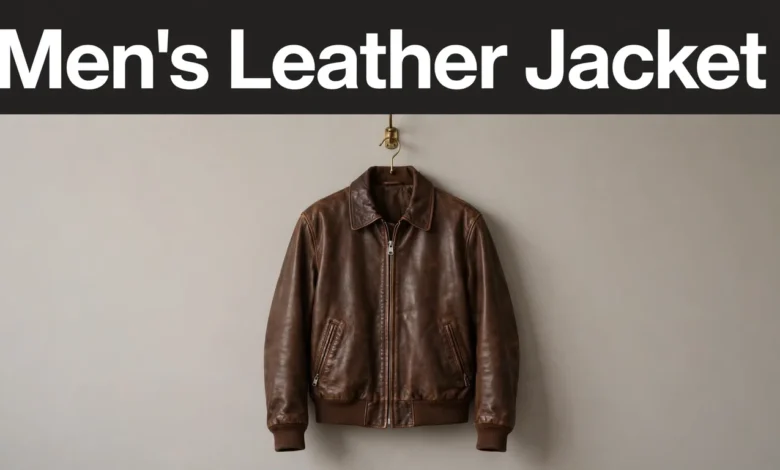
A men’s leather jacket is one of those rare pieces of clothing that can last for years, look better as it ages, and work in more situations than most people expect. It can be worn with jeans and a T-shirt on a casual day, layered over a shirt for a smarter evening out, or thrown on over a hoodie when the weather turns cool. Few jackets offer that range.
The problem is that buying one is not as simple as picking a colour. Leather jackets come in several distinct styles, different types of leather, and different fits, and the price range is wide. A jacket that looks great on a model can feel wrong on you if the style does not suit your build or your wardrobe, and a cheap jacket made from poor leather can look tired after a single season.
This guide walks through the main styles, explains how a men’s leather jacket should fit, compares the common types of leather, and gives you a practical checklist for choosing one you will actually wear. No jargon, no hype — just the detail you need before you spend your money.
More Information: How Often Does a Solar Eclipse Happen? A Simple Guide
What Is a Men’s Leather Jacket?
The bottom line: a men’s leather jacket is an outerwear jacket made from animal leather — most commonly cowhide, lambskin, or goatskin — cut in one of several classic styles that have been worn for decades.
Leather jackets first became widely known through military and motorcycle use in the early to mid twentieth century, and the classic styles we still see today — the biker, the bomber, and the racer — all trace back to practical garments designed for warmth, wind protection, and durability. Over time they moved from workwear and uniform into everyday fashion, and they have stayed there because the material itself is hard-wearing and the shapes are simple and flattering.
What makes leather different from fabric is how it behaves. It blocks wind well, it resists light rain better than most cloth jackets, and it develops a patina — a softening and darkening in the places that flex and wear — that many owners value. A good leather jacket does not stay looking brand new; it becomes personal, moulding slightly to the wearer over time.
That is also why quality matters. A well-made leather jacket can last for many years with basic care. A poorly made one, with thin leather, weak stitching, or a cheap lining, can lose its shape and finish quickly. The rest of this guide is about telling the difference before you buy.
The Main Styles of Men’s Leather Jacket
Most men’s leather jackets fall into a small number of classic styles. Learning to tell them apart is the fastest way to narrow your choice, because each style has a different look, a different level of formality, and a different set of outfits it works with.
The Biker Jacket
The biker jacket is the most recognisable leather jacket of all. It usually has an asymmetrical front zip, wide lapels that can be fastened up, belted waist and cuffs, and often a quilted shoulder or back panel. It was designed for motorcyclists, so it is cut to be worn sitting forward on a bike, with room across the shoulders and a shorter body that does not bunch up when seated.
In everyday wear, the biker jacket has a confident, slightly rebellious character. It pairs naturally with jeans and boots, and it looks best when the rest of the outfit is simple — a plain T-shirt or a dark shirt underneath lets the jacket do the talking. It is the least formal of the classic styles, and it suits men who like a strong, defined silhouette.
The Bomber Jacket
The bomber jacket, also called a flight jacket, has a simpler, rounder shape: a front zip, ribbed cuffs and hem, and a soft, unstructured collar. It was originally designed for pilots who needed warmth without bulk, and that relaxed, practical origin still shows in the way it fits and feels.
Bombers are the most versatile of the leather styles. They work with jeans, chinos, and even smart trousers, and they suit a wider range of builds because the shape is less fitted than a biker. If you want one leather jacket that covers the most situations, a bomber in black or dark brown is often the safest choice.
The Racer Jacket
The racer jacket is the minimalist of the group. It has a small, neat collar — often a band collar or a simple snap collar — a straight front zip, and clean lines with very little decoration. It was designed for café racers and track riders who wanted a streamlined jacket with nothing to flap in the wind.
Because it is so clean, the racer jacket looks smarter than a biker and slightly more tailored than a bomber. It works well with a shirt, dark jeans, and leather shoes, and it is a good choice if you want a leather jacket that can be dressed up a little without looking formal.
The Trucker Jacket
The leather trucker jacket borrows its shape from the classic denim trucker: a button front, two chest pockets, and a straight, boxy body. It has a more casual, workwear feel than the other styles, and it layers easily over a shirt or a sweater.
Truckers are a good option if you like the look of leather but find biker jackets too bold or bombers too round. They are relaxed, practical, and easy to wear, and they suit men who prefer a straightforward, unfussy jacket.
The Field and Field-Style Jacket
Some leather jackets take their shape from field and utility jackets, with a longer body, more pockets, and a belted waist. These are less common than the four styles above, but they suit men who want extra coverage and storage, and who like a rugged, outdoors look. They are generally more casual and work best with boots and jeans.
| Style | Look | Formality | Best With |
|---|---|---|---|
| Biker | Bold, asymmetrical zip | Casual | Jeans, boots, T-shirt |
| Bomber | Round, relaxed, ribbed cuffs | Casual to smart-casual | Jeans, chinos, trainers or boots |
| Racer | Clean, minimal, neat collar | Smart-casual | Dark jeans, shirt, leather shoes |
| Trucker | Button front, chest pockets | Casual | Shirt, jeans, casual boots |
| Field-style | Longer body, extra pockets | Casual | Jeans, boots, outdoor layers |
Types of Leather Used in Men’s Jackets
The type of leather affects how a jacket feels, how it wears, and how much it costs. Three types dominate the men’s leather jacket market, and each has its own character.
Cowhide
Cowhide is the most common leather for men’s jackets, and for good reason. It is thick, tough, and durable, and it holds its shape well. A cowhide jacket feels substantial when you put it on, and it can take years of wear. It is also the heaviest of the three main types, and it can feel stiff when new, softening gradually with wear.
Fun fact: the stiffness of a new cowhide jacket is not a fault — it is a sign of thick, full leather. Most cowhide jackets soften noticeably after a few weeks of regular wear.
Lambskin
Lambskin is much softer and lighter than cowhide. It feels smooth and supple from the first wear, and it drapes more easily, which is why it is often used for smarter, more fitted jackets such as racers and fashion bombers. The trade-off is durability: lambskin is thinner and more prone to scratches and scuffs, so it needs a little more care.
If comfort and a soft feel matter most to you, and you are willing to look after the jacket, lambskin is a lovely choice. If you want a jacket you can wear hard without worrying about marks, cowhide is the safer bet.
Goatskin
Goatskin sits between cowhide and lambskin. It is lighter than cowhide but tougher than lambskin, with a slightly pebbled texture that many people like. It resists water reasonably well and wears in nicely. It is less common than the other two, but it is a good middle ground if you want durability without the weight of cowhide.
Other leathers, such as buffalo hide and sheepskin with a shearling lining, also appear in men’s jackets. Buffalo is thick and rugged; shearling-lined jackets are very warm but bulkier. For a first leather jacket, however, cowhide, lambskin, or goatskin covers almost every need.
| Leather | Feel | Durability | Weight | Best For |
|---|---|---|---|---|
| Cowhide | Firm, substantial | Very high | Heavy | Everyday hard wear, bikers |
| Lambskin | Soft, smooth, supple | Moderate | Light | Smart, comfortable jackets |
| Goatskin | Supple, lightly textured | High | Medium | A balance of comfort and toughness |
Full-Grain, Top-Grain and Genuine Leather: What the Labels Mean
Leather labels can be confusing, and the words on a tag do not always mean what they sound like. Understanding three terms will help you judge quality.
Full-grain leather is the top layer of the hide with its natural grain intact. It is the strongest and most durable grade, and it develops the best patina over time. It is also the most expensive, and it is a good sign when a jacket is described this way.
Top-grain leather is the top layer with the surface lightly sanded or corrected to remove imperfections. It is still good quality — smooth, durable, and widely used in quality jackets — but it will not develop quite the same character as full-grain over many years.
Genuine leather is the term that causes the most confusion. Despite sounding like a mark of quality, it is actually a lower grade: it is made from the layers below the top grain, and it is less durable and less attractive than full-grain or top-grain. A jacket labelled only “genuine leather” is not necessarily bad, but it is not a premium material, and the price should reflect that.
The bottom line: if you are paying a premium price, look for full-grain or top-grain on the label. If the label says only “genuine leather” or “leather” with no grade, ask what grade it is, or judge the jacket by its feel, weight, and stitching rather than by the label alone.
How a Men’s Leather Jacket Should Fit
Fit is where most leather jacket purchases succeed or fail. Leather does not drape like cloth, so a jacket that is too big looks boxy and shapeless, while one that is too small restricts your movement and pulls at the zip.
Shoulders
The shoulder seams should sit on your natural shoulder line, not drooping down your arm and not pulling inwards. This is the hardest part of a jacket to alter, so get the shoulders right first and worry about the body second.
Chest and Body
The jacket should close comfortably over a T-shirt or a light shirt, without pulling at the zip or buttons. You should be able to pinch a little fabric at the side, but not a large handful. If you plan to layer a thick sweater underneath, try the jacket on over that sweater — a jacket that fits over a T-shirt may be too tight over knitwear.
Sleeves
The sleeves should reach your wrist bone when your arms hang naturally, covering a shirt cuff but not swallowing your hand. When you raise your arms, the sleeves will ride up a little — that is normal with leather — but they should not pull the whole jacket up with them.
Length
Most classic leather jackets end at or just below the belt. A bomber or biker that ends at the waist is correct for the style. A longer field-style jacket will end at the hip or below. What you do not want is a jacket that ends halfway up your torso, or one that covers your pockets and looks like a coat.
The Movement Test
Try the jacket on and move in it. Sit down, raise your arms, and cross them in front of you. The jacket should allow these movements without digging in at the armpits or pulling hard across the back. New leather can feel stiff at first, but it should not be painful or restrictive. If it is, try the next size up or a different style.
How to Choose the Right Men’s Leather Jacket
Choosing well comes down to matching the jacket to your life, not just to a picture. Work through these questions in order, and the choice usually narrows itself.
1. What will you wear it with? If you mostly wear jeans and T-shirts, a biker or a bomber will fit straight in. If you often wear a shirt and dark trousers, a racer or a smart bomber is a better match. Look at what you already own and choose a jacket that works with it, not one that needs a new wardrobe.
2. What colour suits you? Black is the classic choice and the most versatile with dark clothes. Dark brown is warmer and softer, and it pairs well with earth tones, blues, and lighter denim. Tan and lighter browns look striking but show wear and marks more easily, and they suit a more casual wardrobe. For a first jacket, black or dark brown is usually the safest choice.
3. What leather do you want? Choose cowhide for toughness and longevity, lambskin for softness and comfort, and goatskin for a balance of the two. If you ride a motorcycle, a thicker cowhide biker is the practical choice. If you want a jacket for evenings out, lambskin will feel more comfortable.
4. What is your budget, honestly? Leather jackets range from affordable high-street options to premium pieces that cost many times more. A mid-priced jacket from a reputable maker, in full-grain or top-grain leather, is often better value than a very cheap jacket that will need replacing in a year. Set a budget you are comfortable with, and judge the jacket by its leather, stitching, lining, and hardware within that budget.
5. Check the details before you buy. Look at the zips — they should run smoothly and feel solid, not flimsy. Look at the stitching — it should be even, with no loose threads. Look at the lining — it should be neatly fitted, not bunched or pulling. Check the pockets: they should be deep enough to be useful and securely stitched. These details are where quality shows, and where cheap jackets usually cut corners.
More Information: GamerAfter.com: What It Is and How Gamers Use It Daily
6. Try it on with your usual clothes. If you can, try the jacket on in a shop with the clothes you will wear it with. If you are buying online, check the size guide against a jacket you already own, and check the return policy before you order. Leather jackets are a considered purchase, and a good return policy removes much of the risk.
What to Wear With a Men’s Leather Jacket
A leather jacket is easy to style once you keep the rest of the outfit simple. The jacket is the statement piece, so the clothes underneath should support it rather than compete with it.
Classic casual: a plain white or black T-shirt, dark jeans, and boots or clean trainers. This is the most reliable combination, and it works with a biker, a bomber, or a racer.
Smart-casual: a dark shirt, dark jeans or chinos, and leather shoes or boots. A racer or a bomber works best here. Keep the shirt simple — a plain or subtly checked shirt looks better than a loud pattern under leather.
Layered for cold weather: a hoodie or a sweater under a biker or bomber, with jeans and boots. The jacket blocks the wind, the layer underneath provides warmth, and the combination looks relaxed and intentional.
What to avoid: wearing a leather jacket with leather trousers can look like a costume unless you are actually riding. Very formal clothes — a suit and tie, for example — do not pair well with a leather jacket. And a very busy, patterned shirt under a bold biker jacket can make the outfit look cluttered. Keep it simple, and the jacket will look its best.
How to Care for a Leather Jacket
Leather is a natural material, and a little care goes a long way. You do not need to do much, but what you do matters.
Keep it dry, and dry it slowly. If your jacket gets wet, let it air dry at room temperature, away from direct heat such as a radiator or a hair dryer. Heat can dry leather out and make it stiff or cracked. Stuffing the jacket lightly with clean towels while it dries can help it keep its shape.
Condition it occasionally. A leather conditioner, applied sparingly a few times a year, keeps the leather supple and helps prevent drying and cracking. Use a conditioner made for the type of leather you have, test it on a hidden area first, and apply a thin layer rather than soaking the jacket.
Clean it gently. Wipe off dust and light dirt with a soft, dry cloth. For marks, a slightly damp cloth is usually enough. Avoid household cleaners, harsh soaps, and solvents, which can strip the leather’s finish. For serious stains or damage, a professional leather cleaner is the safer choice.
Store it properly. Hang the jacket on a wide, sturdy hanger — not a thin wire one — so the shoulders keep their shape. Store it in a cool, dry place, and avoid plastic covers, which can trap moisture. If you will not wear the jacket for a season, a breathable cloth cover is a better choice.
Do not wash it in a machine. Leather jackets should not be machine washed or tumble dried. If the lining needs freshening, air the jacket out, or take it to a cleaner who handles leather.
Common Mistakes When Buying a Leather Jacket
Buying too big. Many men size up because leather feels stiff at first. A jacket that is too big will look boxy and will not improve with wear. Buy the size that fits your shoulders and chest now, and let the leather soften around you.
Choosing style over fit. A biker jacket is a great style, but if it does not suit your build or your wardrobe, it will sit unworn. Choose the style that fits your life, not just the one that looks best in a photograph.
Judging by price alone. A high price does not guarantee quality, and a low price does not always mean poor quality. Judge the leather, the stitching, the zips, and the lining, and let those details guide you.
Ignoring the lining. A cheap, poorly fitted lining makes a jacket uncomfortable and can tear quickly. Check that the lining is smooth, securely attached, and appropriate for the climate you live in — a heavy quilted lining is warm, a light lining is more versatile.
Expecting it to stay perfect. Leather changes with wear. Small scuffs, softening, and a developing patina are normal, and many owners value them. If you want a jacket that looks brand new forever, leather may not be the right material for you — but if you like the idea of a jacket that ages with you, it is hard to beat.
Pros and Cons of a Men’s Leather Jacket
| Pros | Cons |
|---|---|
| Durable and long-lasting with basic care | Can be expensive for good quality |
| Blocks wind and resists light rain | Heavier than most fabric jackets |
| Looks better as it ages | Needs occasional conditioning and care |
| Versatile across casual and smart-casual outfits | Not ideal in very hot weather |
| Classic styles rarely go out of fashion | Fit and style choice matter a lot |
The bottom line: a leather jacket is an investment in a piece you can wear for years, but only if you choose the right style, the right leather, and the right fit. Get those three things right, and the jacket will repay you every time you wear it.
Frequently Asked Questions
How should a men’s leather jacket fit?
The shoulder seams should sit on your natural shoulder line, the jacket should close comfortably over a T-shirt or light shirt without pulling, the sleeves should reach your wrist bone, and the body should end around the belt. You should be able to move your arms and sit down without the jacket digging in or pulling hard across the back.
Which leather is best for a men’s leather jacket?
There is no single best leather — it depends on what you want. Cowhide is the toughest and most durable, lambskin is the softest and lightest, and goatskin sits in between. For hard everyday wear, cowhide is a good choice. For comfort and a smarter look, lambskin is a good choice.
Are leather jackets warm?
Leather jackets block wind well, which makes them feel warm in cool weather, but they are not heavily insulated on their own. A jacket with a quilted or shearling lining is warmer than an unlined one, and layering a sweater or hoodie underneath makes a big difference in cold weather.
Can you wear a leather jacket in the rain?
A leather jacket can handle light rain, and most types of leather resist water reasonably well for a short time. It is not a raincoat, however, and it should not be soaked. If it gets wet, let it air dry slowly at room temperature, away from direct heat.
How do I stop my leather jacket from cracking?
Keep it away from direct heat and prolonged sunlight, do not let it dry out completely, and condition it occasionally with a suitable leather conditioner. Storing it on a wide hanger in a cool, dry place also helps. Cracking is usually caused by the leather drying out, so regular, light conditioning is the best prevention.
Is a black or brown leather jacket better?
Both are classic choices. Black is more versatile with dark clothes and has a bolder, more modern feel. Dark brown is warmer and softer, and it pairs well with blues, earth tones, and lighter denim. For a first jacket, choose the colour that matches the clothes you already wear most often.
How long does a good leather jacket last?
A well-made leather jacket, in full-grain or top-grain leather and looked after with basic care, can last for many years — often a decade or more of regular wear. The exact lifespan depends on the leather, the construction, and how it is worn and stored, but longevity is one of the main reasons people choose leather.
Conclusion
A men’s leather jacket is a purchase worth taking your time over. Choose the style that fits your wardrobe, the leather that fits how you will wear it, and the size that fits your shoulders and chest. Check the zips, stitching, and lining before you buy, and do not be rushed by a bargain that compromises on those details.
Once you have the right jacket, look after it simply: keep it dry, condition it occasionally, clean it gently, and store it on a good hanger. Do that, and it will soften, develop character, and stay in your wardrobe for years — which is exactly what a good leather jacket is for.
Read Also: Levi’s Free Shipping Coupon: How to Save on Orders