
Volglaswanden: 7 Verrassende Voordelen voor een Modern en Stijlvol Interieur
Volglaswanden: 7 Verrassende Voordelen voor Interieur
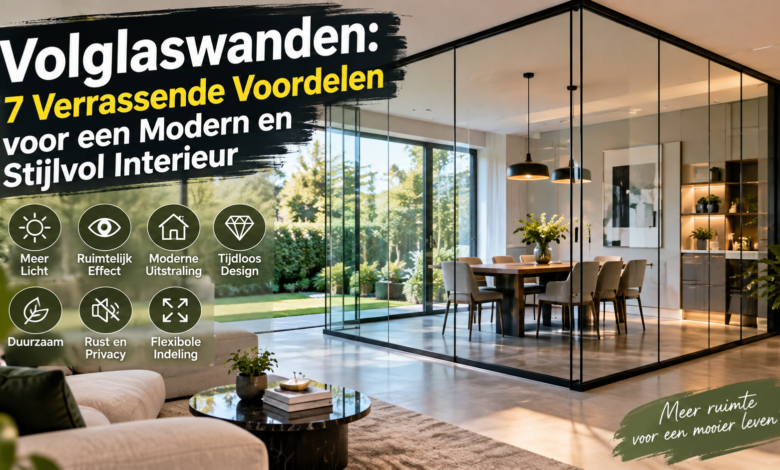
Full-glass walls are partition systems made of full glass, designed to divide interior spaces while preserving light, visibility, and an open atmosphere. They are increasingly used in modern offices, meeting rooms, retail spaces, hospitality settings, and contemporary homes. Unlike solid walls, they create separation without making a room feel closed or visually heavy. Their appeal comes from the combination of natural light, clean design, flexibility, and practical room division. Depending on the specification, glass partitions can also provide privacy, acoustic control, and safety. This makes them useful in interiors where appearance and functionality must worktogether.
Quick Overview
| Feature | Details |
|---|---|
| Main purpose | Interior room division |
| Common setting | Offices, homes, showrooms, meeting rooms |
| Main material | Safety glass |
| Design | Transparent, minimalist, or customized |
| Privacy options | Frosted glass, films, partial opacity |
| Acoustic options | Acoustic and double-glazed systems |
| Main advantage | Separation without losing visual openness |
| Maintenance | Regular glass cleaning is required |
Who is volglaswanden?
The Dutch term volglaswanden refers to full-glass partition walls used mainly to divide interior spaces. It is not a person, company, or public figure, but a category of architectural interior solutions. A typical system uses large glass panels supported with minimal profiles or carefully concealed connections. Depending on the design, panels may be installed with aluminum profiles at the floor and ceiling while the glass-to-glass connections remain visually subtle.
The concept is particularly relevant to contemporary architecture because it combines physical separation with visual continuity. Instead of completely closing off a room, a glass partition lets people, daylight, and interior features remain visible across different zones.
Early Development and Background
Glass has long been used in architecture, but modern interior partition systems have made it easier to use large panels safely and consistently. Contemporary systems commonly rely on tempered or laminated safety glass, with specifications chosen based on the application and building requirements.
The development of minimalist framing has also changed the appearance of interior glass walls. Rather than emphasizing heavy structural elements, many modern designs reduce visible profiles. This creates a cleaner surface and makes the Glass itself the dominant architectural feature.
Today, the technology is used in both commercial and residential environments. Offices remain a particularly common application because businesses need separate rooms without sacrificing openness.
Career and Practical Applications
How Volglaswanden Work in Modern Interiors
The main role of volglaswanden is to create defined spaces while retaining visual and light connections. In an office, for example, a glass partition can separate a conference room from an open workspace. Employees still see the room, while the meeting area gains a clear physical boundary.
This approach can be useful when an interior needs several functions. A large floor plan might include individual offices, meeting rooms, reception areas, quiet work zones, and collaborative spaces. Glass partitions can define these areas without the visual weight of conventional masonry or drywall construction.
One of the biggest benefits is natural light transmission. Glass lets daylight pass between spaces that might otherwise rely on artificial lighting. This can help an interior feel brighter and more connected, although the actual energy impact depends on the building, orientation, lighting controls, and other design factors.
A second advantage is spatial perception. Transparent surfaces reduce visual barriers, which can make compact areas appear more open. This is valuable in smaller offices, apartments, studios, and retail environments where every part of the floor plan matters.
Third, Glass supports a wide range of design styles. Clear panels can create a minimalist appearance, while dark framing can produce an industrial character. Frosted surfaces, decorative films, and partial opacity can add visual variation while retaining some of Glass’s advantages.
Fourth, consider acoustic performance during specification. Not every glass wall provides the same sound control. Single glazing, double glazing, laminated acoustic Glass, seals, doors, and installation details all influence the final result. For confidential meetings or focused workspaces, evaluate the complete partition system rather than judging performance by appearance alone.
Fifth, privacy can be customized. Clear Glass provides maximum visibility, while frosted Glass, films, patterns, or partially opaque sections can reduce direct views. This allows designers to balance openness with the practical need for visual separation.
Sixth, maintenance is relatively straightforward because smooth glass surfaces can be cleaned without repainting or replacing wall finishes. However, fingerprints, dust, and streaks show more on transparent surfaces, especially around frequently used doors.
Seventh, modern glass partition systems can accommodate different door configurations. You can integrate swing and sliding doors depending on the layout and requirements.
Rise to Public Recognition
The popularity of volglaswanden is closely connected to the growth of open-plan and contemporary interior design. Businesses increasingly seek workplaces that combine collaboration with dedicated areas for meetings and concentration. Glass provides one way to divide these functions while maintaining a sense of connection.
The same principle applies to homes and commercial interiors. Designers can create separate zones without visually fragmenting the entire floor plan. As minimalist architecture has become more common, the demand for slim profiles and clean glass surfaces has also increased.
However, popularity should not be confused with universal suitability. A glass partition must still meet the project’s requirements for privacy, safety, acoustics, accessibility, and building regulations.
Personal Considerations
Choosing volglaswanden is primarily a design and functional decision, not simply an aesthetic one. Before installation, users should consider how the space will actually be used.
A meeting room may need stronger acoustic performance than a simple office divider. A hallway installation may require greater attention to visibility and safety. A home application might prioritize privacy, while a showroom may prioritize transparency.
Also consider direct sunlight, cleaning requirements, door traffic, furniture placement, and future layout changes. A professional assessment can help determine the right glass specification and mounting system.
Major Life Events
For an interior project, the important stages are planning, specification, installation, and maintenance. The planning stage defines the partition’s purpose and identifies requirements such as privacy and sound control.
During specification, you select the glass type, thickness, framing, doors, seals, and finishes. Installation then determines how accurately the system fits the existing structure. Check safety and construction requirements before work begins, as they can vary by location and application.
Public Image and Legacy
The visual identity of volglaswanden is strongly associated with modern architecture. Their clean surfaces and transparency can support minimalist, industrial, contemporary, and professional interiors.
Their lasting value is less about a specific design trend and more about the system’s principle: separating spaces without completely disconnecting them. That combination remains useful in workplaces and other interiors where daylight, visibility, and flexibility are important.
Why People Search for volglaswanden
People commonly search for volglaswanden when planning a renovation, office redesign, or modern interior. They may want to understand the advantages, costs, privacy options, acoustic performance, glass types, or installation requirements.
Searchers may also compare full-glass partitions with traditional walls or framed glass systems. The most important questions usually involve whether the system suits their space and which specification best balances appearance, safety, privacy, and performance.
Privacy, Accuracy and Public Information
Glass manufacturers, interior contractors, architectural specialists, and building professionals mainly provide reliable information about volglaswanden. Their documentation shows that performance varies significantly between systems.
Claims about sound reduction, safety, energy performance, and durability should therefore be evaluated against the specific product and installation method. Clear Glass alone does not guarantee acoustic privacy or compliance with every building requirement.
Conclusion
Volglaswanden offer a practical way to divide modern interiors without sacrificing light and visual openness. Their advantages include flexible layouts, contemporary aesthetics, customizable privacy, and potential acoustic performance. However, the right solution depends on the building, room function, glass specification, and installation details. When you consider these factors together, full-glass partitions can offer a balanced mix of design, separation, transparency, and functionality.
More Lifestyle: Discover inspiring interiors, home trends, modern living ideas, and practical lifestyle tips at 9Bio.co.uk
(FAQs)
What are volglaswanden?
Volglaswanden are full-glass partition systems designed to divide interior spaces while preserving light and visual openness. They are commonly used in offices, meeting rooms, homes, retail environments, and other modern interiors. Depending on the design, they can incorporate safety glass, privacy treatments, acoustic solutions, and integrated glass doors.
What are the main benefits of volglaswanden?
The main benefits include natural light transmission, a spacious visual effect, modern styling, flexible room division, and continued visibility between areas. Acoustic and privacy options are also available. Their exact performance depends on the selected Glass, framing, doors, seals, and installation method, not the wall’s appearance alone.
Are volglaswanden suitable for offices?
Yes. Volglaswanden are widely used in offices to create meeting rooms, private offices, reception areas, and focused workspaces without completely closing off the surrounding environment. They can help maintain daylight and visual connection while creating defined areas. Consider acoustic specifications when confidential conversations or focused work are important.
Do glass walls provide privacy?
Clear Glass provides limited visual privacy because people can see through it. However, you can increase privacy with frosted Glass, decorative films, patterned surfaces, or partially opaque sections. Acoustic privacy is a separate consideration and requires appropriate Glass, seals, doors, and construction details. Therefore, plan visual and sound privacy separately.
Are volglaswanden difficult to maintain?
They are generally straightforward to maintain because you can clean glass surfaces with standard glass-cleaning methods. However, fingerprints, dust, and streaks can be noticeable, especially on doors and high-touch areas. Regular cleaning is therefore important for a consistently clear appearance.
What should you consider before installing volglaswanden?
Consider the room’s purpose, required privacy, acoustic needs, safety requirements, door configuration, available space, maintenance, and applicable building rules. The glass specification should match the project, not just the appearance. Professional measurement and installation are particularly important for large panels and specialized systems.
