
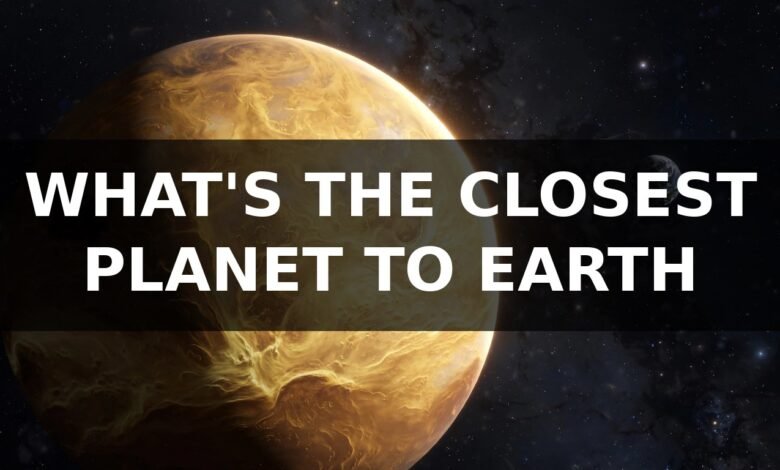
What’s the closest planet to Earth? If you have ever looked up at the evening sky and spotted a bright, steady light hanging low near the horizon, there is a good chance you were looking at the answer to this question. The closest planet to Earth is Venus — at least, that is the answer most of the time, and the one you will find in most school textbooks.
But the full story is a little more interesting than that, because planets never sit still. They are all travelling around the Sun at different speeds and on different paths, so the distance between Earth and any other planet is always changing. Ask the same question on a different date and you can get a different answer.
Venus wins when you measure the smallest possible gap between two planets. At its very closest, Venus comes within about 41 million kilometres (roughly 25 million miles) of Earth. No other planet can get that near to us. Mars comes next, and Mercury comes third on that measure. But if you ask a slightly different question — which planet is, on average, our nearest neighbour over a long stretch of time — the answer flips, and Mercury takes the lead. Both answers are correct. They just measure different things, and understanding why tells you a lot about how the solar system actually moves.
The Short Answer
Venus is the closest planet to Earth. When Venus passes between Earth and the Sun, a moment astronomers call inferior conjunction, the gap between the two planets shrinks to around 41 million kilometres. That is the smallest distance that ever separates Earth from another planet.
There is one twist worth knowing straight away. If you average the distance between Earth and each planet over many years, Mercury ends up closest. Mercury’s orbit keeps it near the Sun, and because it circles the Sun quickly, it spends more of its time on Earth’s side of the solar system than Venus does. So Venus holds the record for the closest approach, while Mercury holds the record for the closest average. Keep both facts in mind and you will never be caught out by this question again.
Why Closest Is Trickier Than It Sounds
It is tempting to picture the solar system as a neat row of planets lined up in order, each one sitting at a fixed distance from the next. In reality, the planets are spread around the Sun like runners on separate circular tracks, each moving at its own pace. Earth takes a year to complete one lap. Venus takes about 225 days. Mercury, the fastest of all, takes only 88 days. Mars takes nearly two years. So the gap between Earth and any other planet stretches and shrinks constantly as the two worlds move around their orbits.
That is why astronomers usually talk about two different kinds of distance. The first is the closest approach: the smallest gap that ever opens up between two planets, which happens when they line up on the same side of the Sun. The second is the average distance over a full cycle of orbits, which tells you which planet is typically nearest. Most people mean the first one when they ask this question, and that is why Venus is the standard answer. But the second measure is just as real, and it produces a surprise that catches plenty of people off guard.
There is also the question of how distance is measured. Straight-line distance through space is what matters here, not distance along an orbit. Two planets can be near each other in their orbits yet far apart in space if they happen to be on opposite sides of the Sun. At those moments, Venus can be more than 250 million kilometres away from us, even though it is our nearest planetary neighbour in the other sense.
Venus: The Closest Planet at Its Nearest
Venus is often called Earth’s sister planet, and the nickname fits. It is almost the same size as Earth, with a diameter of about 12,100 kilometres compared with Earth’s 12,700. It is made of rock, like Earth, and it sits in the orbit right inside ours, closer to the Sun. When Venus swings around to the same side of the Sun as Earth, the two planets face each other across a gap of only about 41 million kilometres. On the scale of the solar system, that is practically next door.
Light from the Sun reaches Venus in a little over six minutes, and a radio signal sent from Earth to Venus at closest approach would take just over two minutes to arrive.
You can also see why Venus dominates our sky. It is the brightest planet we can see from Earth, and the third brightest object in the sky overall after the Sun and the Moon. Its thick clouds reflect sunlight so well that Venus often outshines every star. People have known it for thousands of years, calling it the morning star when it appears before sunrise and the evening star when it appears after sunset. Ancient observers did not realise the morning star and the evening star were the same object, but both of them were Venus.
For all its family resemblance, Venus is a deeply unwelcoming place. Its thick atmosphere is mostly carbon dioxide, and the heat it traps has driven the surface temperature to around 465 degrees Celsius, hotter than a kitchen oven and hotter than Mercury, even though Mercury sits much closer to the Sun. The air pressure at the surface is crushing, and the clouds are made of sulphuric acid. A handful of probes have landed there and survived for a couple of hours at most before the heat and pressure destroyed them. So while Venus is our closest planetary neighbour, it is not a place anyone will be visiting in person any time soon.
How Close Each Planet Gets to Earth
The table below shows the smallest possible distance between Earth and each of the other planets, and the largest distance when the two planets sit on opposite sides of the Sun. The numbers are rounded, because orbits are slightly oval rather than perfect circles, so the exact figures shift a little from one line-up to the next.
| Planet | Closest approach to Earth | Farthest distance from Earth |
|---|---|---|
| Venus | About 41 million km | About 261 million km |
| Mars | About 55 million km | About 401 million km |
| Mercury | About 77 million km | About 222 million km |
| Jupiter | About 589 million km | About 968 million km |
| Saturn | About 1.2 billion km | About 1.66 billion km |
| Uranus | About 2.57 billion km | About 3.16 billion km |
| Neptune | About 4.31 billion km | About 4.69 billion km |
Two things stand out from this table. First, Venus clearly wins on closest approach, coming nearer to us than any other planet by a wide margin. Second, look at the farthest column: Mercury never gets as far away from Earth as Venus or Mars can. Mercury’s whole orbit is small and tucked in close to the Sun, so even at its most distant it stays within about 222 million kilometres of us. That limited range is exactly why Mercury ends up being our closest neighbour on average, which is the subject of the next section.
Mercury: The Planet That Is Closest on Average
Here is the twist that surprises most people. If you take the average distance between Earth and each planet over a long period, Mercury comes out on top. A study that simulated the positions of the planets over thousands of years found that Mercury is, on average, closer to Earth than Venus is, and closer than Mars too. The reason is simple once you picture it. Mercury orbits close to the Sun and whips around it every 88 days, so it spends a large share of its time on the same side of the Sun as Earth.
Venus, by contrast, spends long stretches on the far side of the Sun, where the distance between the two planets grows to more than 250 million kilometres.
Think of it like neighbours in a small town. Venus is the neighbour who sometimes pops round and stands right at your door, closer than anyone else ever gets, but who also goes away for long trips. Mercury is the neighbour who never comes quite that close, but who is almost always somewhere nearby. If you ask who is nearest right now, the answer is usually Venus. If you ask who is nearest most of the time, the answer is Mercury.
Mercury itself is a strange little world. It is the smallest planet in the solar system, only a little bigger than our Moon, and it has almost no atmosphere to speak of. That means its surface swings between extremes: scorching hot on the side facing the Sun and bitterly cold on the night side. Its surface is covered in craters, much like the Moon, and it has a huge iron core for its size. Because it stays so close to the Sun in our sky, it is hard to spot, and many people have never knowingly seen it. But on average, it is the planet that keeps us company most closely.
Mars: The Runner-Up That Gets All the Attention
Mars is the planet most people think of first when they picture our nearest neighbour, and there are good reasons for that. It is the planet we have explored the most, with rovers driving across its surface right now and orbiters circling above it. It is also the planet most often talked about as a future home for astronauts. But in pure distance terms, Mars comes second to Venus. At its closest, when Earth and Mars line up on the same side of the Sun, the gap shrinks to about 55 million kilometres. That line-up, called an opposition, happens roughly every 26 months, and keen skywatchers look forward to it because Mars appears at its biggest and brightest.
What Mars lacks in closeness it makes up for in familiarity. It is a rocky world about half the size of Earth, with a thin atmosphere, polar ice caps, and the largest volcano in the solar system, Olympus Mons, which rises to about 22 kilometres high. Its red colour comes from iron-rich dust covering its surface, and that colour is so distinctive that Mars is easy to pick out in the night sky even without a telescope. When Mars is at its closest, it shines brightly with a warm orange glow that is hard to miss.
The reason Mars draws so much attention despite being farther away than Venus is that it is a far more practical destination. Venus is hellishly hot with crushing air pressure, while Mars is cold and dry but survivable with the right equipment. A trip to Mars still takes months, but the planet offers solid ground, water ice, and daylight conditions that future explorers could work with. So Mars may be second on distance, but it is first on the list of places humans actually hope to visit.
What About the Moon?
Some people wonder whether the Moon counts as the closest planet to Earth. It is certainly the closest large object in space to us, sitting at an average distance of about 384,400 kilometres. That is far closer than Venus ever gets. But the Moon is not a planet. It is Earth’s natural satellite, a smaller body that orbits Earth rather than orbiting the Sun on its own. Planets, by definition, orbit the Sun directly, and the Moon orbits us.
That distinction matters, but it is worth pausing on the comparison because it puts the planetary distances in perspective. Venus at its closest is more than a hundred times farther away than the Moon. Even Mercury, which never gets as close as Venus, is still around two hundred times farther away than the Moon at its nearest. The Moon is practically in our backyard. The planets, even the closest ones, are distant travellers that only occasionally swing near.
How Astronomers Measure the Distance
You might wonder how anyone can know these distances so precisely when nobody has ever stretched a tape measure across space. The answer is radar. Astronomers bounce radio signals off a planet’s surface and time how long the signal takes to come back. Since radio waves travel at the speed of light, the round-trip time gives the distance directly. This technique has been used since the 1960s, and it pinned down the distances in the solar system far more accurately than earlier methods.
Spacecraft have sharpened the numbers further. Probes orbiting Venus and Mars, and landers and rovers on the surface of Mars, send back signals that let scientists track their positions to within metres. Telescopes on Earth also help, by watching how a planet’s apparent position shifts against the background stars as Earth moves around the Sun. Put together, these methods give us distances we can trust to a remarkable degree.
There is one more unit worth knowing. Astronomers often measure distances in astronomical units, where one AU is the average distance from Earth to the Sun, about 150 million kilometres. In those terms, Venus orbits at about 0.72 AU from the Sun, Earth at 1 AU, Mars at about 1.52 AU and Mercury at about 0.39 AU. Venus at its closest is about 0.28 AU from Earth, which is the same 41 million kilometres in different clothing. Using AU makes it easy to compare the layout of the solar system at a glance.
Can You See the Closest Planet Tonight?
Yes, very often. Venus is one of the easiest planets to spot, and you do not need a telescope or any special equipment. The trick is knowing when and where to look. Venus never strays far from the Sun in the sky, so it only ever appears low near the horizon, shortly after sunset or shortly before sunrise. It looks like a brilliant, steady white light, noticeably brighter than any star, and it does not twinkle the way stars do.
If Venus is an evening star, look toward the west just after the Sun goes down. If it is a morning star, look toward the east before dawn. There are free stargazing apps that can point you in the right direction on any given night, and they will also tell you whether Venus is currently visible from where you live. Mercury is much harder to catch, because it stays even closer to the Sun and is often lost in the glare, so spotting it feels like a small achievement. Mars, by contrast, is visible for much of the night around its opposition, glowing orange high in the sky.
One thing to remember is that Venus goes through phases, just like the Moon. Through a small telescope you can watch it change from a nearly full disc to a thin crescent as it moves around its orbit. When it is closest to Earth, it appears as a large, thin crescent, and at its farthest it looks small and almost full. Galileo was the first to observe these phases, and they were one of the early pieces of evidence that the planets orbit the Sun rather than the Earth.
Does the Closest Planet Ever Change?
The title of closest planet changes hands depending on the date, but only between Venus and Mercury in practical terms. Right now, and for most of any given year, Venus is the nearest planet to Earth in the straightforward sense. As the planets move, there are stretches when Mercury is actually nearer in straight-line distance, particularly when Venus is on the far side of the Sun. Mars can also briefly be the nearest planet when it is at opposition and Venus is far away, though that is less common.
Over a full cycle of the planets’ orbits, the pattern repeats. Venus comes closest to Earth every 584 days, a period astronomers call the synodic period, which is the time between one inferior conjunction and the next. Each of those close passes brings Venus within roughly 41 million kilometres, though the exact distance varies slightly because the orbits are not perfect circles. Mars oppositions come every 26 months, and the very closest ones, when Mars is also near the closest point of its own orbit, are special events that skywatchers mark on their calendars years in advance.
So the answer to the question never really settles on a single name for all time. Venus holds the record and takes the title most often. Mercury is the quiet, steady neighbour that is closest on average. And Mars steps into the spotlight every couple of years when it swings near. Which one counts as closest depends on when you ask and what you mean by close.
Frequently Asked Questions
What is the closest planet to Earth?
Venus is the closest planet to Earth. At its nearest approach, it comes within about 41 million kilometres (around 25 million miles) of us. No other planet can get that close.
Is Mars or Venus closer to Earth?
Venus is closer. Venus can come within about 41 million kilometres of Earth, while Mars at its very closest is still about 55 million kilometres away. Mars only seems nearer because we hear about it more often and have sent far more missions there.
Is Mercury closer to Earth than Venus?
On average, yes. Mercury’s orbit keeps it near the Sun, and it circles the Sun quickly, so averaged over many years Mercury spends more time near Earth than Venus does. But at any single moment, Venus can come much closer than Mercury ever can.
What is the closest planet to Earth in miles?
Venus, at about 25 million miles away at its closest. Mars follows at about 34 million miles, and Mercury at about 48 million miles at its nearest point.
Can you see Venus from Earth?
Yes, Venus is the brightest planet in our sky and is easy to see with the naked eye. Look low in the west after sunset or low in the east before sunrise. It appears as a bright, steady white light that does not twinkle like a star.
How long would it take to travel to Venus?
With current spacecraft, a trip to Venus takes a few months. The exact time depends on the positions of the two planets and the path the spacecraft takes, but robotic probes have typically needed between three and five months to make the journey.
Why is Venus called Earth’s sister planet?
Venus is called Earth’s sister planet because it is almost the same size as Earth and is made of similar rocky material. The two planets formed in the same part of the solar system, but their climates turned out very differently: Earth stayed mild and wet, while Venus became scorching hot under a thick blanket of carbon dioxide.
Conclusion
So, what is the closest planet to Earth? The simple answer is Venus, which can come within about 41 million kilometres of us, closer than any other planet ever gets. The fuller answer is that it depends on how you measure closeness. Averaged over time, Mercury is the planet that stays nearest to Earth most often, quietly circling the Sun close by while Venus wanders off to the far side. Mars, meanwhile, is the neighbour we know best and the one we are most likely to visit, even though it never comes quite as close as Venus.
The next time you spot a bright, steady light low in the evening sky, take a moment to appreciate what you are looking at. That is Venus, our closest planetary neighbour, shining across a gap of tens of millions of kilometres. It is a reminder that the solar system is not a still picture but a moving dance, and the distances between worlds are always changing.
What’s the Closest Planet to Earth? A Quick Recap
What’s the closest planet to Earth? Venus is the closest planet to Earth at its nearest approach, while Mercury stays closest on average.
Ask what’s the closest planet to Earth on any given day, and the answer is usually Venus.
Read Also: Warner’s Bras: Styles, Fit and How to Choose Yours





One Comment