Dentiloquent Meaning: What Does This Rare Word Really Mean?
Dentiloquent Meaning: Fascinating Truth Behind Rare Words
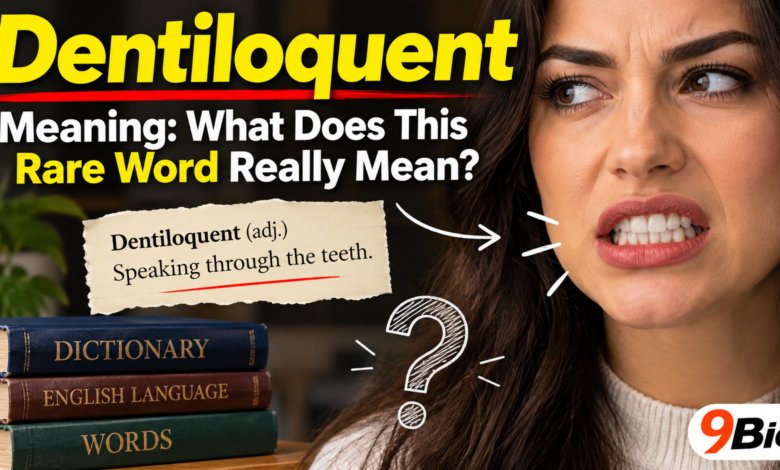
Dentiloquent is a rare English adjective that means speaking through the teeth. It describes a manner of speech in which someone talks while keeping the teeth close together or the jaw relatively restricted. The term is unusual in modern everyday English, which is why people often search for its meaning, origin, pronunciation, and correct usage.
Unlike a personal name or biography subject, dentiloquent is a vocabulary term, not a person. Current dictionary evidence supports its basic meaning, while historical references show that the word has appeared in English vocabulary for centuries. Collins currently lists it as a New Word Suggestion and says its usage is being monitored.
Quick Facts
| Detail | Information |
|---|---|
| Word | Dentiloquent |
| Part of speech | Adjective |
| Basic meaning | Speaking through one’s teeth |
| Common modern phrase | Speaking through clenched teeth |
| Usage | Rare and uncommon |
| Dictionary status | Listed by Collins as a New Word Suggestion |
| Historical reference | Documented in Thomas Blount’s 1656 Glossographia |
| Related noun | Dentiloquy |
| Main context | Vocabulary, descriptive writing, language study |
What Is Dentiloquent?
Dentiloquent describes speech produced through or between the teeth. In simple English, it means talking while the teeth are held together or very close together. The word focuses primarily on the physical manner of speaking, rather than automatically describing the speaker’s personality, emotions, or intentions.
For example, someone might deliver a reply without opening their mouth normally, producing words through a tightly held jaw. A writer could describe that reply as dentiloquent. A more familiar expression is “speaking through clenched teeth,” which most readers find easier to understand.
The distinction matters because some online explanations connect the word directly with anger or frustration. Those emotions can accompany this type of speech, but they are not part of the core definition supported by dictionary evidence. Collins defines the term simply as “talking through one’s teeth.”
Early History and Background
The history of dentiloquent is more interesting than its rarity might suggest. An academic discussion of unusual early English vocabulary identifies the word in Thomas Blount’s Glossographia, published in 1656. This provides historical evidence that the term was recorded in English long before its recent appearance on vocabulary websites.
The historical record should still be interpreted carefully. A word appearing in an old dictionary does not necessarily prove that it was widely used in ordinary conversation. Some obscure vocabulary survived mainly through dictionaries and later reference works.
The related noun dentiloquy is also documented in historical dictionaries and refers to the practice or habit of speaking through the teeth. Together, these records help establish that the concept has a genuine history in English vocabulary.
Career, Usage and Linguistic Context
Because dentiloquent is a word rather than a person, it has no career, occupation, or professional biography. Its relevance comes from its linguistic function and how writers use it to describe speech.
Grammatically, it functions as an adjective. It can therefore modify words connected with communication, including “voice,” “speech,” “reply,” “remark,” “delivery,” or “response.” A sentence such as “He gave a dentiloquent reply” describes how the reply was delivered rather than what the speaker actually meant.
The term is particularly useful in descriptive writing because it compresses a longer physical description into one adjective. Instead of writing that a character kept their teeth together while speaking, a writer can use the unusual word when the context makes its meaning clear.
However, rare vocabulary has a practical limitation. Most readers are unfamiliar with the term, so writers should provide enough context to make its meaning obvious. In general-interest content, “speaking through clenched teeth” is more immediately understandable.
The word should also not be confused with stuttering, mumbling, whispering, or a speech disorder. A person can speak through their teeth without having any diagnosed communication condition. Likewise, the term does not automatically indicate anger, hostility, or emotional distress.
Rise to Public Recognition
The modern attention surrounding dentiloquent appears to come largely from online searches for unusual English vocabulary rather than from a major cultural event. Its unusual spelling and highly specific meaning make it attractive to readers exploring rare words.
Collins provides an important modern reference point. Its entry identifies the term as a New Word Suggestion, submitted in 2012, and states that the word is being monitored for evidence of usage.
That status is important because it prevents a common misunderstanding. An online definition does not automatically mean a word is common, mainstream, or widely accepted in contemporary English.
Personal Life and Meaning
Personal life does not apply to dentiloquent because the term does not identify an individual. It is a descriptive adjective that characterizes a particular manner of speaking.
The physical image behind the word is straightforward. A speaker keeps the teeth together or close while continuing to articulate words. Depending on the situation, the resulting speech may sound restricted, tense, or compressed.
Treat those qualities as possible effects rather than fixed meanings. The word itself does not establish why the speaker is talking that way.
Marriage and Family
Marriage, relationships, children, and family history don’t apply to dentiloquent because it is a linguistic term rather than a person or public figure.
Instead, we can discuss its word family. The related noun “dentiloquy” describes the practice of speaking through the teeth. Historical dictionary sources connect the two terms through the same basic idea of speech produced with the teeth held together.
This distinction is useful when researching rare vocabulary because related forms can provide additional historical context without requiring unsupported biographical information.
Major Life Events
No personal life events are associated with dentiloquent. The important milestones are linguistic rather than biographical.
One significant historical reference is its appearance in Thomas Blount’s Glossographia in 1656. Another is its modern listing in Collins as a New Word Suggestion submitted in 2012.
These records demonstrate that the term has documented historical and modern reference points, while its actual everyday usage remains limited.
Public Image and Legacy
The public profile of dentiloquent is best understood as that of a rare vocabulary item. It is not a widely used term in ordinary American English, but it remains interesting because it gives a precise name to a recognizable manner of speaking.
Its linguistic legacy also illustrates how English preserves unusual words. Some terms remain common, while others survive primarily through dictionaries, literary usage, language discussions, and specialized vocabulary lists.
The word therefore has historical value even though most speakers would choose a simpler phrase.
Why People Search for Dentiloquent
People search for dentiloquent mainly because the word is unfamiliar and its spelling does not immediately reveal its meaning. Searchers may encounter it in vocabulary quizzes, word lists, language articles, or educational material.
Common questions include what dentiloquent means, whether it is a real word, how it is pronounced, where it originated, and how to use it in a sentence.
The simplest answer remains: it means speaking through the teeth.
Privacy, Accuracy and Public Information
No private biography exists to investigate because dentiloquent is not a person. Accurate research therefore depends on distinguishing documented linguistic evidence from claims repeated across websites.
The strongest evidence reviewed here supports the basic definition and confirms historical and modern reference points. Collins explicitly describes the term as a New Word Suggestion under usage monitoring. Historical research also connects it with Blount’s 1656 Glossographia.
Claims about emotions, popularity, or specialized medical meanings should not be treated as part of the definition without stronger evidence.
Conclusion
Dentiloquent is a rare English adjective with a surprisingly long documented history. Its central meaning is simple: speaking through the teeth. Historical evidence connects the term with Thomas Blount’s 1656 Glossographia, while Collins currently records it as a New Word Suggestion under usage monitoring.
Although uncommon in modern conversation, the word remains useful for understanding unusual English vocabulary and precise descriptions of speech.
More Celebrity: Explore in-depth biographies, career journeys, family backgrounds, and the latest updates on your favourite celebrities at 9Bio.co.uk.
(FAQs)
What does dentiloquent mean?
Dentiloquent means speaking through one’s teeth. It describes a manner of speech in which the speaker talks while holding the teeth together or keeping them closely positioned. The expression “speaking through clenched teeth” communicates the same basic idea in more familiar everyday English.
Is dentiloquent a real English word?
Yes. Dentiloquent is a documented English term. Collins lists it as a New Word Suggestion and defines it as talking through one’s teeth. Historical research also identifies the word in Thomas Blount’s 1656 Glossographia. Its documented existence should not be confused with widespread modern usage.
Is dentiloquent commonly used today?
No. Dentiloquent is considered rare vocabulary rather than a normal English word. Most speakers would probably say “speaking through clenched teeth” because the phrase is immediately understood. Collins currently treats the term as a New Word Suggestion and says its usage is being monitored.
Does dentiloquent mean speaking while angry?
Not necessarily. Dentiloquent describes the physical manner of speaking, not a specific emotion. A person might speak through their teeth because of tension, discomfort, restraint, or another circumstance. Anger can be part of the context, but it should not automatically be treated as the word’s definition.
What is the origin of dentiloquent?
The term belongs to a vocabulary family connecting teeth with speech. Historical evidence places dentiloquent in Thomas Blount’s Glossographia (1656). The related noun “dentiloquy” has also been used for the practice of speaking through the teeth.
How can dentiloquent be used in a sentence?
A simple example is: “He gave a dentiloquent reply without fully opening his mouth.” The sentence uses the adjective to describe how the reply was delivered. For general readers, however, “He replied through clenched teeth” would usually be clearer and more natural.